In This Topic
- Video: Q&A About Smoke Wood
- Appropriate Smoke Woods
- Which Woods Go With Which Meats
- Woods To Avoid
- Mixing Smoke Woods
- Flavored Smoke Woods
- Logs, Slabs, Chunks, Chips, And Pellets
- Should Smoke Wood Be Soaked In Water Before Use?
- Should Bark Be Removed?
- Quantity Of Smoke Wood To Use
- How To Add Smoke Wood To The Fire
- Visible Smoke: How Much & For How Long?
- Where To Buy
- By The Bag, Box, Or Truckload
Since the Weber Smokey Mountain Cooker uses charcoal as its fuel source, and charcoal by itself doesn’t impart a lot of wood flavor to barbecued meats, we use smoke wood to enhance the flavor and aroma of the foods that we cook.
According to Cook’s Illustrated magazine, it’s the lignin in wood that when burned gives us the smoky aroma we associate with barbecue, including notes of clove and vanilla, and sugars in wood’s cellulose and hemicellulose create flavor molecules similar to those in caramel. These flavor compounds float up from the fire and dissolve into the surface moisture of the meat. Other compounds from the burning wood are responsible for the lacquered surface color of barbecued meats.
Here are the basics you need to know about smoke woods and their use in the WSM. As always…click on any of the pictures to view a larger image.
Video: Q&A About Smoke Wood
This video discusses most of the topics covered in this article.
Appropriate Smoke Woods
A variety of sources on the Internet indicate that all the woods listed below are suitable for smoking various types of meat, poultry, or fish. Those shown in bold italics are some of the most popular, most widely available smoke woods.
|
|
|
Generally speaking, you want to use only hardwoods from fruit-bearing or nut-bearing trees. In my experience, fruit woods tend to impart a lighter smoke flavor, while the nut woods produce a stronger smoke flavor. If I could choose only one smoke wood, it would be apple, which seems to complement most everything I barbecue.
Some people say that sassafras is inappropriate for smoking, yet it is available from some mail-order wood suppliers. If you decide to experiment with it, use it sparingly.
Traditionally, barbecuers have used whatever wood is common and abundant in their region. In Texas, post oak and mesquite are the common woods of choice. In parts of the South, it may be hickory and pecan. In the Midwest, hickory and apple. Look around where you live and determine what’s common and plentiful and give that wood a try.
Which Woods Go With Which Meats
Choosing the right type of smoke wood is an important decision each time you barbecue. Each wood imparts its own unique flavor to beef, pork, poultry and seafood. It’s also true that certain woods are commonly associated with and go better with certain kinds of meat.
The table below offers some guidance about which smoke woods and which meats work well together. These are just opinions…your mileage may vary.
| Beef | Pork | Chicken | Fish | Comments | |
| Alder | X | X | – | XX | Delicate flavor |
| Apple | XX | XX | XX | XX | Mild, fruity, goes with any meat |
| Cherry | XX | XX | XX | X | Mild, fruity, goes with any meat |
| Hickory | X | X | X | X | Can be strong, mix with apple/oak |
| Oak | XX | X | X | X | Mild, nutty, great with beef and pork |
| Pecan | X | X | X | – | Sweet, spicy, more assertive than oak |
Below you’ll find pictures and descriptions of the smoke woods I have used in the Weber Smokey Mountain Cooker.
Alder
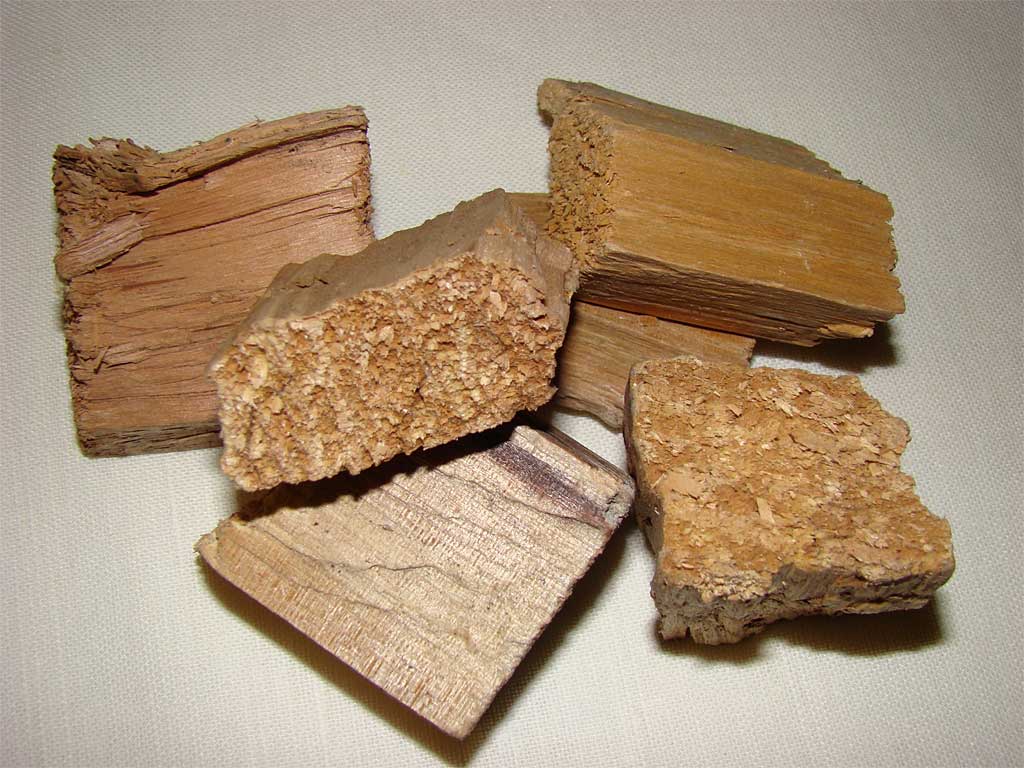
Alder is commonly used with fish, but also works well with beef and pork. It has a light, slightly sweet flavor and is not overpowering. It is much less dense than other smoke woods, and reminds me a little bit of cedar in it’s look and smell.
Apple
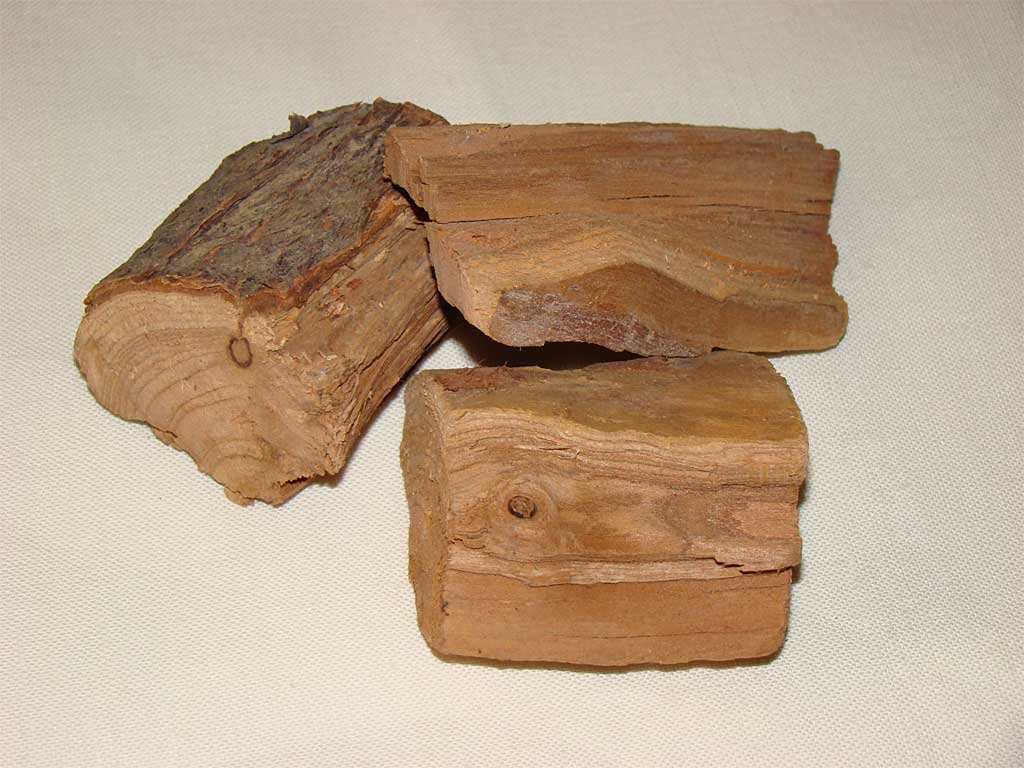
Apple has a light, fruity, slightly sweet aroma and is commonly used with pork and poultry. I especially like to use it with pork ribs. It can be mixed with other smoke woods like oak and cherry with good results.
Cherry
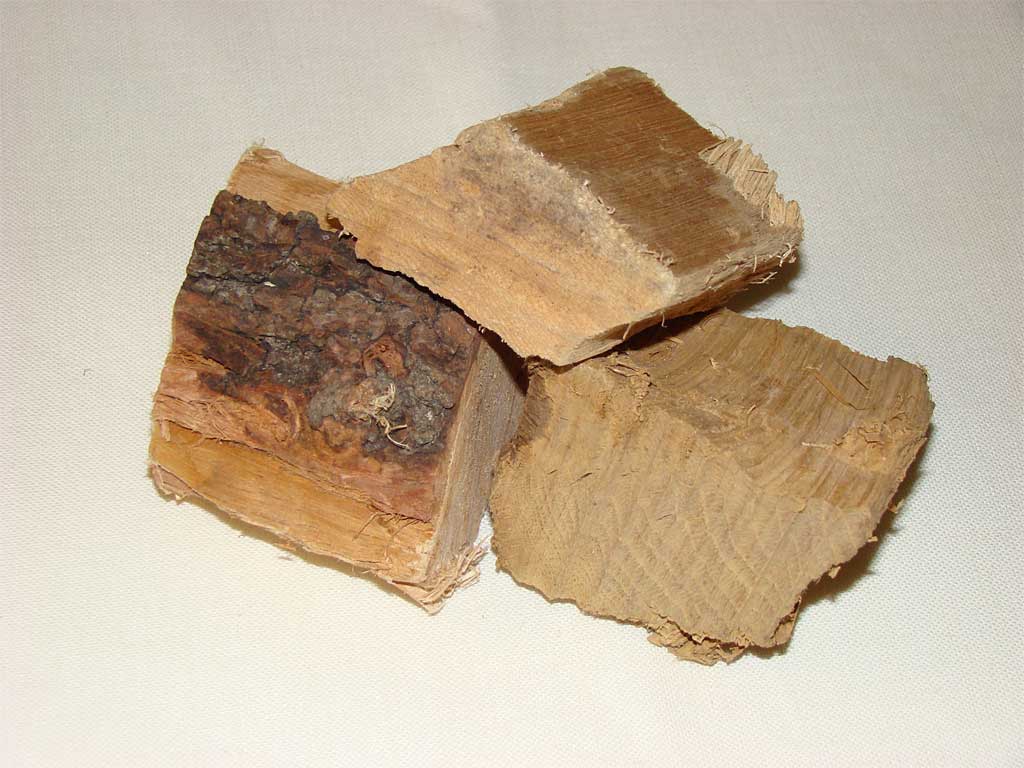
Cherry is one of my favorite woods to use with chicken. It has a slight red color and a subtle, sweet, fruity flavor. It goes well with beef, pork, and poultry and can be mixed with oak and apple.
Guava
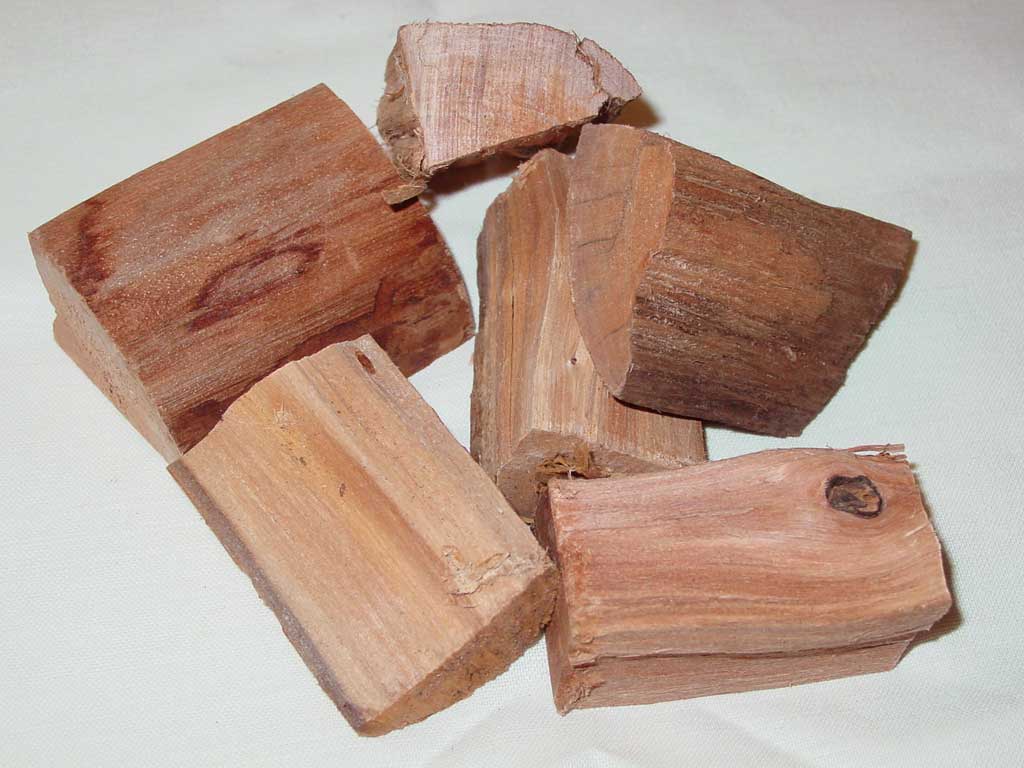
Guava, a member of the Myrtle family, is a fruit wood from Hawaii and other tropical regions. Its semi-sweet aroma goes well with beef, pork, lamb, poultry, and fish.
Hickory
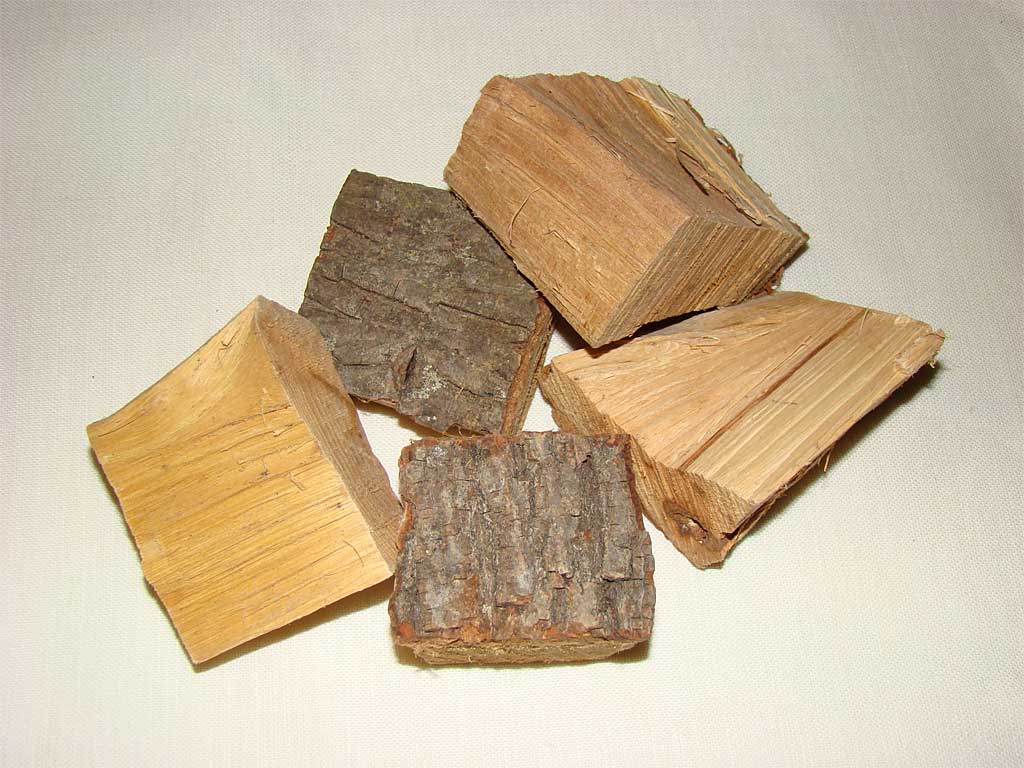
Hickory is probably the most popular smoke wood used in barbecue. It has a strong flavor that complements all meats. Some people find that hickory alone can be overwhelming, especially if too much is used. I never use hickory alone, but mix it with oak. I use two parts oak to one part hickory.
Kiawe
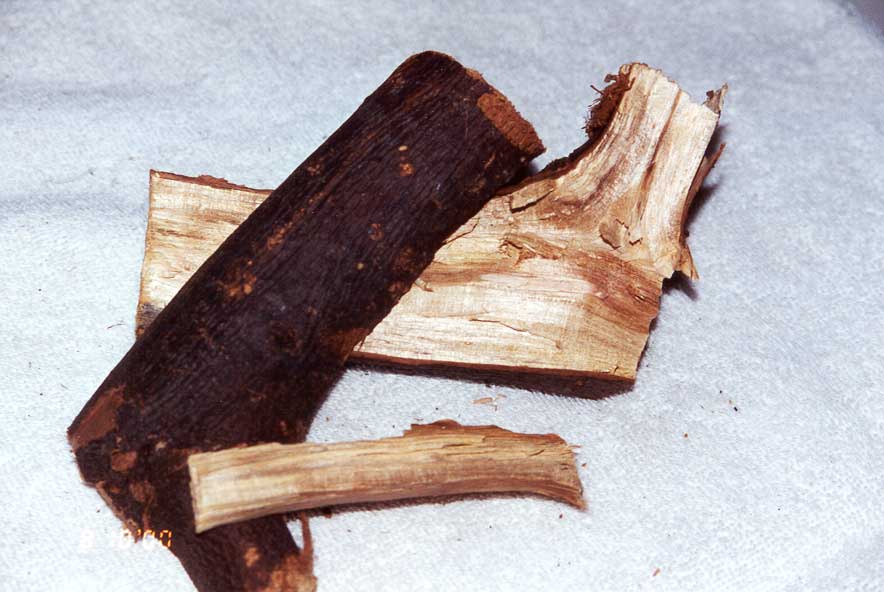
Kiawe (pronounced key-ah-vay) is indigenous to Hawaii and is related to mesquite. It has a strong flavor and works well with beef, fish, or poultry. The wood is very dense and heavy with a dark, smooth, thin bark. You won’t find kiawe in stores…I am fortunate to have a friend who brings me this wood from Hawaii. Give it a try if you’re able to acquire some.
Maple
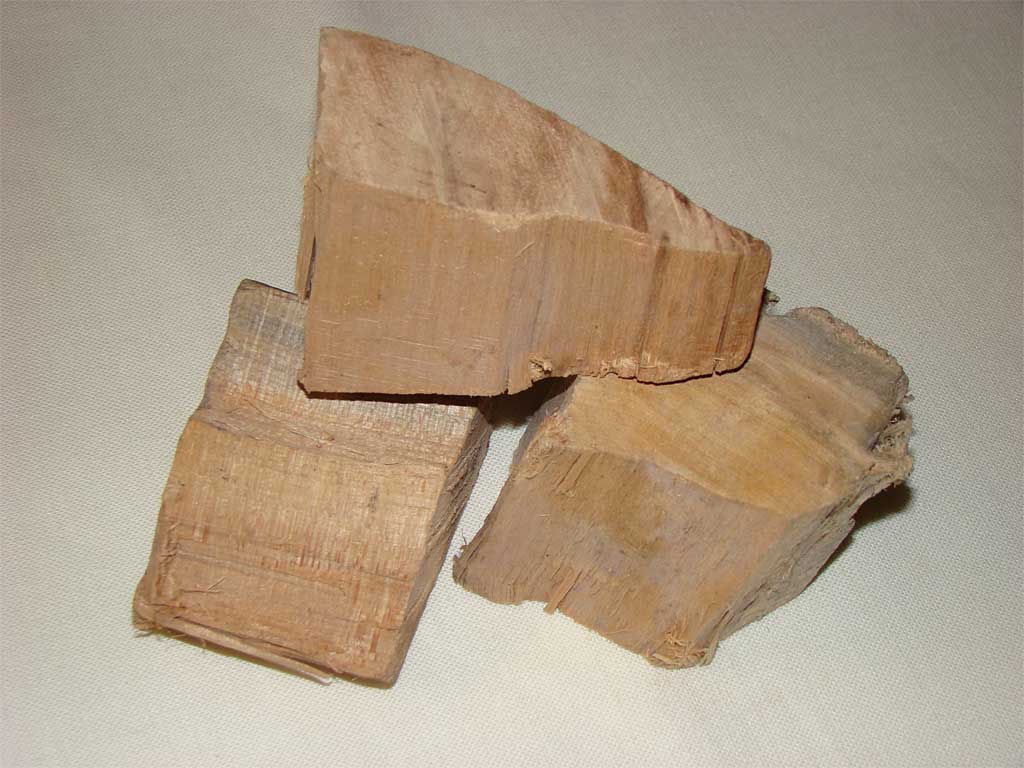
Maple has a mild flavor. Some say it has a slightly sweet flavor because sugar maple, black maple, red maple, and silver maple are commonly used in the production of maple syrup. You’ll have to judge for yourself…I don’t taste sweetness myself. Maple goes especially well with pork and poultry. The wood is dense in weight but light in color.
Mesquite
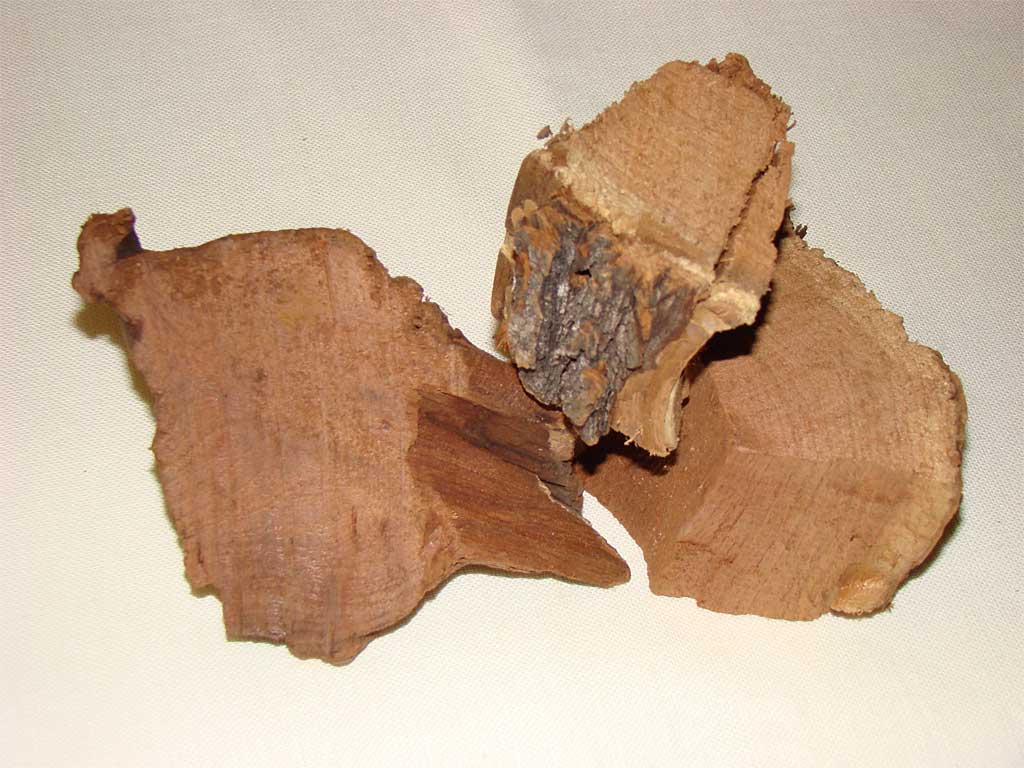
Mesquite is commonly used in Texas barbecue, but it’s often burned down into coals before being used as a heat source in wood-fired cookers. As a smoke wood goes, it’s strong and can easily overpower your food. If used sparingly, it can compliment beef, fish, pork, and poultry. The wood is dense and dark red/brown in color with a very rough bark.
Oak
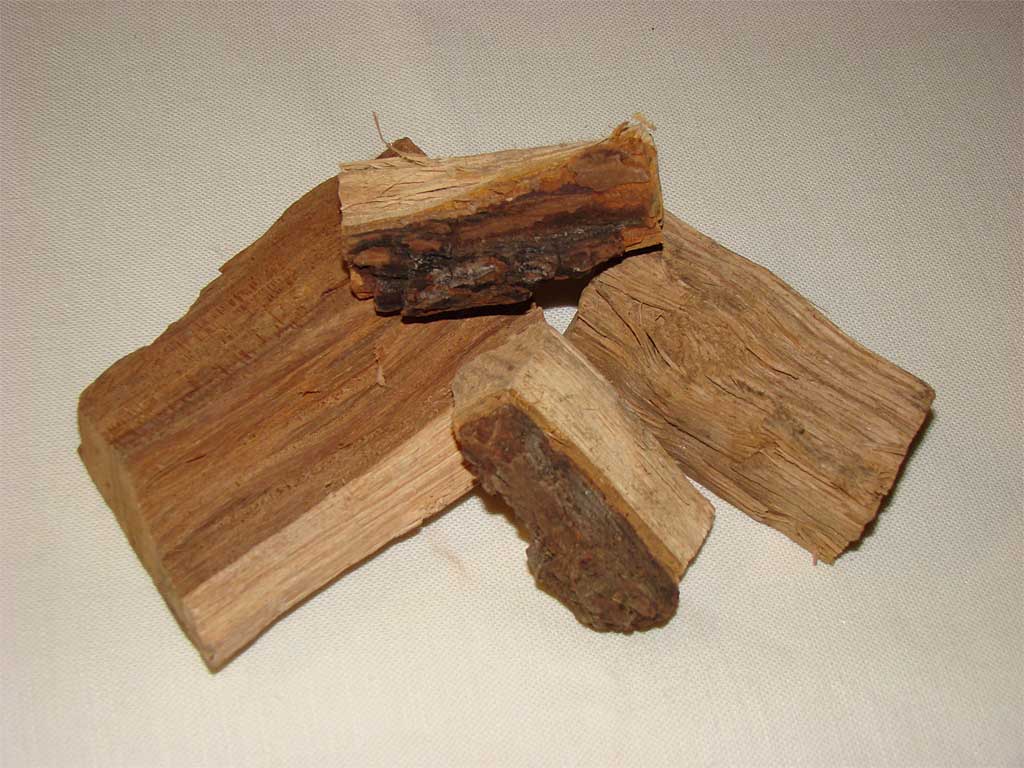
Oak is one of my favorite smoke woods. It goes with just about any barbecue meat. It has a medium smoky flavor that is stronger than apple and cherry, but lighter than hickory. As a result, it mixes well with these three woods, but also works great by itself. It has a dense, tight grain and a color ranging from almost white to yellow to red.
Pecan
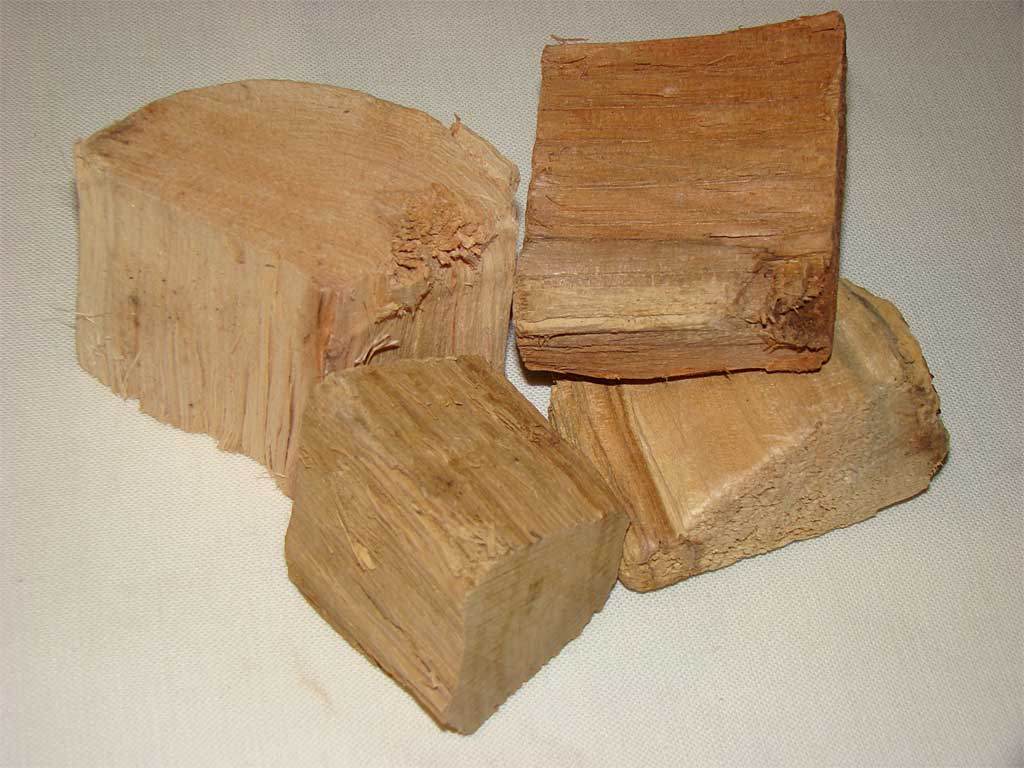
Pecan is great with beef, pork, and poultry. Its flavor is described as spicy and nutty. It can be used by itself or mixed with oak. I especially like it with chicken and ribs.
Wine Barrel Chunks
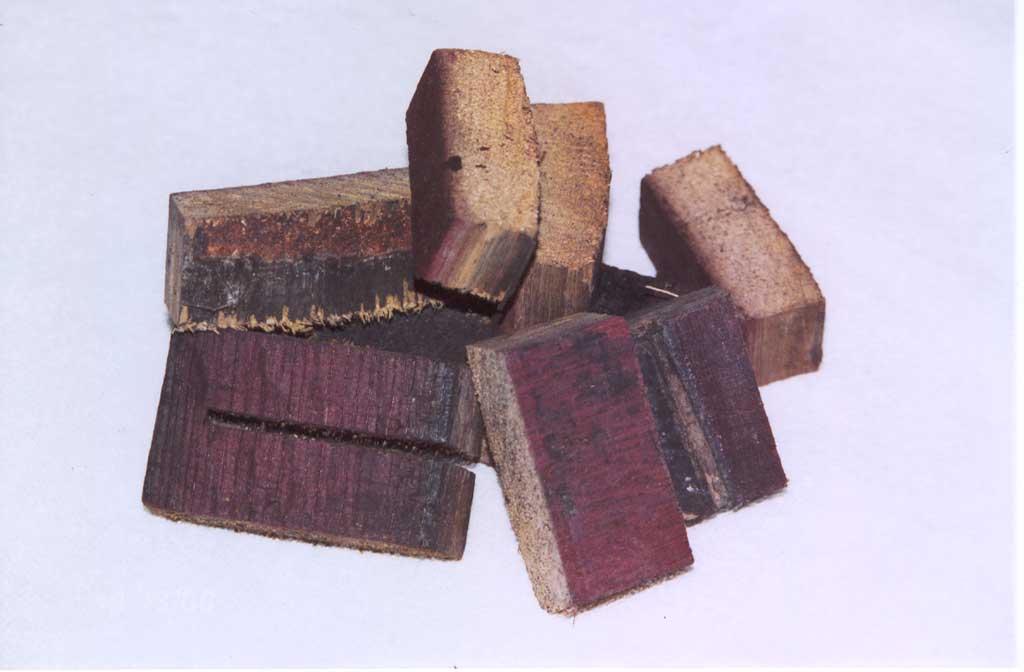
When wine barrels reach the end of their useful life, they’re often cut into chunks and sold as smoke wood. These oak chunks show the dark stain of red wine on one side and the natural oak grain on the other. They have the same aroma you experience when you visit the cellars at a winery. Do they provide a unique flavor to your barbecue? Hard to say, but they’re fun to try if you have the chance.
Woods To Avoid
The conventional wisdom is that cedar, cypress, elm, eucalyptus, liquid amber, pine, redwood, fir, spruce, and sycamore are not suitable for smoking. When in doubt about a particular smoke wood, play it safe—don’t use it until you confirm with a reliable source that it’s OK for use in barbecuing.
Mixing Smoke Woods
You can use a single smoke wood, or you can mix together different types to good effect. Here are some common combos…feel free to experiment to find your favorite!
- Apple + Cherry
- Apple + Hickory
- Apple + Oak
- Cherry + Maple
- Cherry + Oak
- Oak + Hickory
- Oak + Hickory + Apple
- Oak + Pecan
Flavored Smoke Woods
Retailers sell a variety of flavored wood chunks and chips. Some are made from old wine or whiskey barrels, while others have been soaked in wine or even Tabasco. Flavored woods add an interesting aroma to the smoke coming out of your cooker, but you’ll have to judge for yourself whether they do anything for the flavor of your barbecue.
Logs, Slabs, Chunks, Chips, And Pellets
You’ll find smoke wood available in all these forms. In retail stores you’ll most likely find chunks, chips, and pellets. Chunks will vary in size from small pieces to fist-sized pieces. Chunks burn slowly and release smoke over a long period of time and are the best choice of most WSM users.
Chips burn hot and fast, releasing smoke in a quick burst. If you use chips, you will have to add them several times during the cooking process, whereas with chunks you can add them just once at the beginning of the process. To prolong the smoke from wood chips, they are often placed in a pouch formed out of aluminum foil and put directly on the hot coals. Small holes poked in the foil allow the smoke to escape.
Pellets are made from compressed sawdust and come in the same wood varieties as chunks and chips. They are sometimes used in the WSM in a pellet tube for hot or cold smoking fish, cheese, nuts, and more. Pellets are not typically used in the WSM for smoking large cuts of meat like brisket, pork butts, or ribs.
Logs and slabs are usually too large to use in the Weber Bullet, but may be cut down into smaller pieces to fit into the charcoal chamber.
Weber grillmaster Kevin Kolman has described a split log method he uses in lieu of wood chunks in the WSM that he says gives him good results for Texas-style brisket. Kevin lays a 12″ long split piece of post oak across the bottom of the WSM charcoal chamber, fills the empty area around the wood with unlit Weber Charcoal Briquettes, pours a Weber chimney starter full of lit charcoal on top of everything, lets it burn for about 5 minutes, then assembles the cooker. He uses water in the water pan, sets all three bottom vents 1/4 open and the top vent 1/2 open.
Should Smoke Wood Be Soaked In Water Before Use?
Some people like to soak wood chunks in water for several hours or overnight before using them. This is not necessary, especially when using large chunks. Thanks to the vents on the charcoal bowl, the controlled air flow into the WSM allows the chunks to burn slowly throughout the entire cooking session. Besides, water doesn’t penetrate seasoned wood very much anyway.
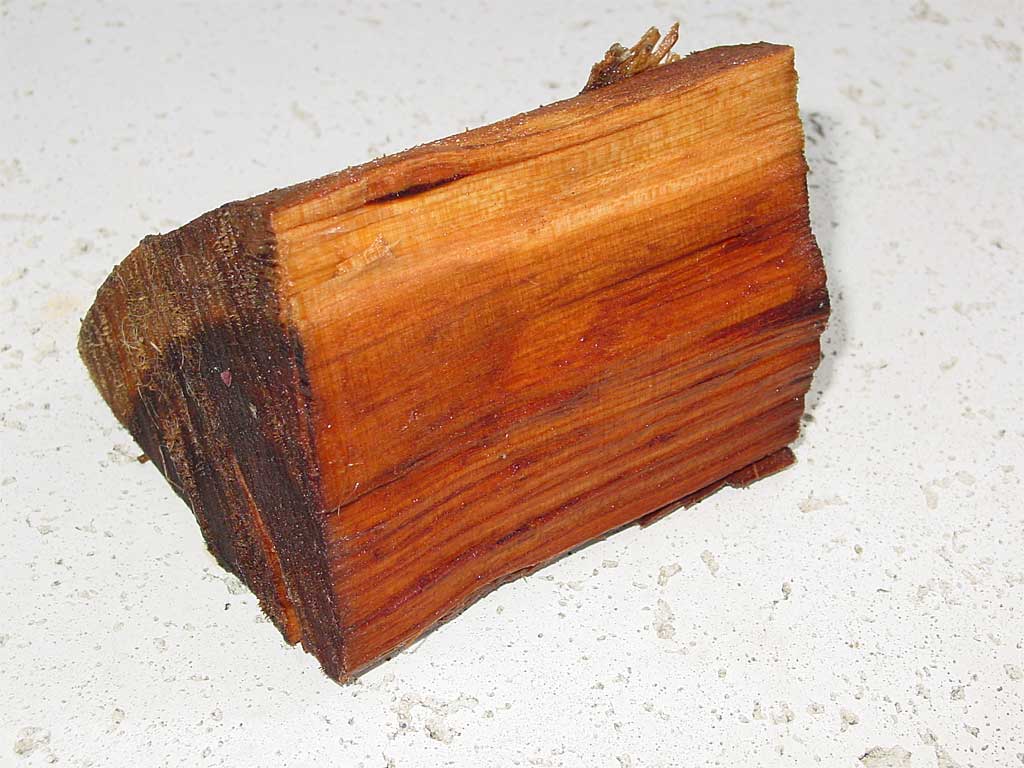
This photo shows a fist-sized chunk of apple that was submerged in water for 24 hours.
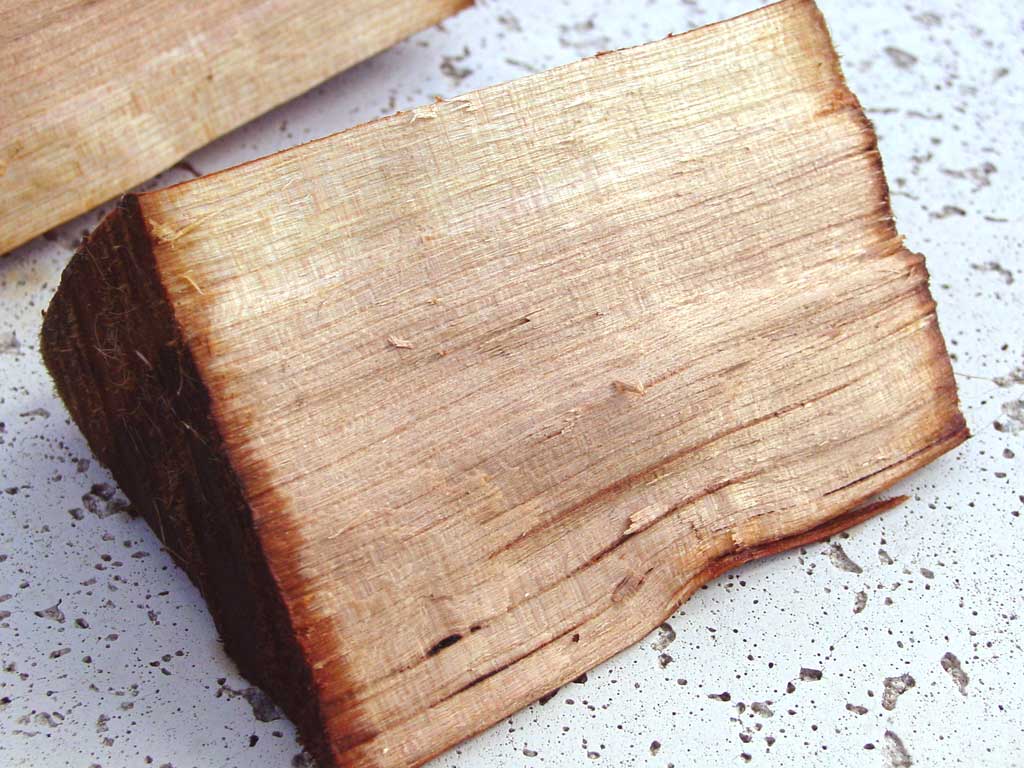
This photo shows the same chunk split open. Notice that there’s barely any water penetration into the wood.
It’s also not necessary to soak wood chips before use if you’re putting them in an aluminum foil pouch. When placing wood chips directly on the fire, soaking them first won’t do much to keep them from bursting into flames.
If you do decide to soak wood chunks or chips, shake off any excess water before adding the wood to the fire.
Should Bark Be Removed?
Some people are adamant about removing the bark from smoke wood, believing that it introduces an undesirable flavor to their barbecue. On the other hand, I know of one gentleman who barbecues using only the bark. I don’t bother removing bark from my smoke wood. You’ll have to try it both ways and see if you can tell any difference.
One of the most famous proponents of removing bark from smoke wood is legendary WSM user Mike Scrutchfield. You can see what he had to say about the subject in the Best Ribs In The Universe article. See the first video at the bottom of the page, timestamp around 3:30.
Quantity Of Smoke Wood To Use
It is possible to apply too much smoke to meat, resulting in a bitter or overpowering flavor. In general, I’ve found that the equivalent of 2-4 fist-sized chunks of wood work best for most meats in the Weber Bullet. You should experiment with using different amounts of smoke wood to determine what works best for you, depending on if you like a heavier or lighter smoke flavor.
When using a new smoke wood for the first time, I suggest using a small amount for a lighter smoke flavor. You can always increase the amount of smoke wood next time, but there’s no way to remove smoke from a piece of meat that’s been oversmoked.
How To Add Smoke Wood To The Fire
Here are some of the ways that people add smoke wood to the fire.
By the way, don’t bother soaking wood chunks before use. It’s not necessary as long as you’re using decent-sized chunks, and the water doesn’t penetrate seasoned wood very much, anyway.
Place Smoke Wood On Top Of Hot Coals
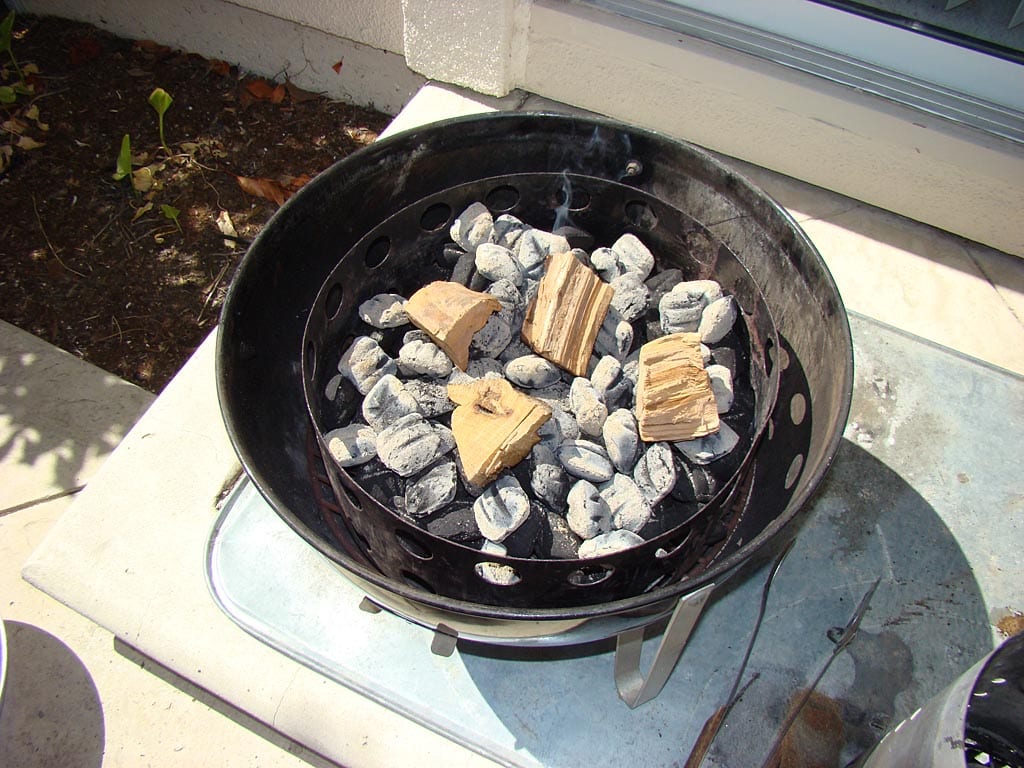
This is my favorite approach regardless of how I fire-up my WSM. Distribute the wood chunks evenly over the surface of the lit charcoal after putting the meat in the cooker. This keeps you from getting blasted with smoke while adding the meat, getting the probe thermometer setup, etc. If using the Minion Method, make sure some wood touches the hot coals to start generating smoke right away.
Bury Smoke Wood In Unlit Charcoal
This method is recommended by my friend Harry Soo of Slap Yo’ Daddy BBQ. I don’t use this method as often as the one shown above, but I do use it occasionally and it works well.
This technique is only possible when firing the cooker using the Minion Method. Bury wood chunks throughout the unlit fuel so the tops of the chunks are exposed.
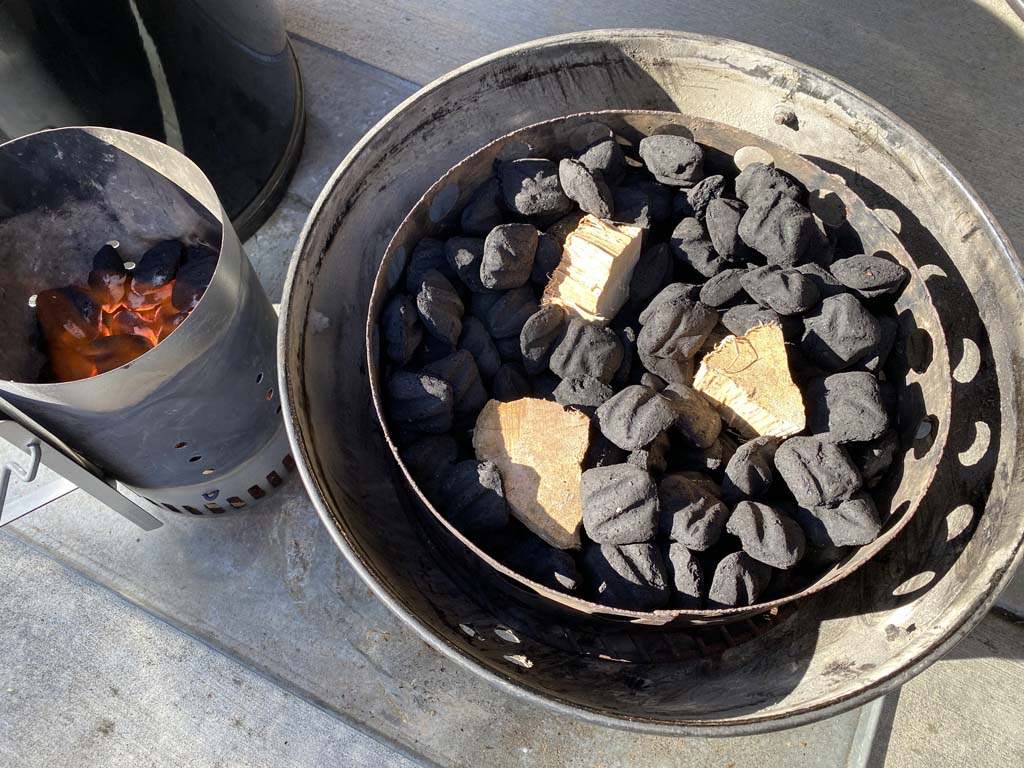 Distribute the hot charcoal evenly over the unlit fuel, making sure some of the coals touch the smoke wood to start generating smoke right away.
Layering Charcoal And Wood Chips
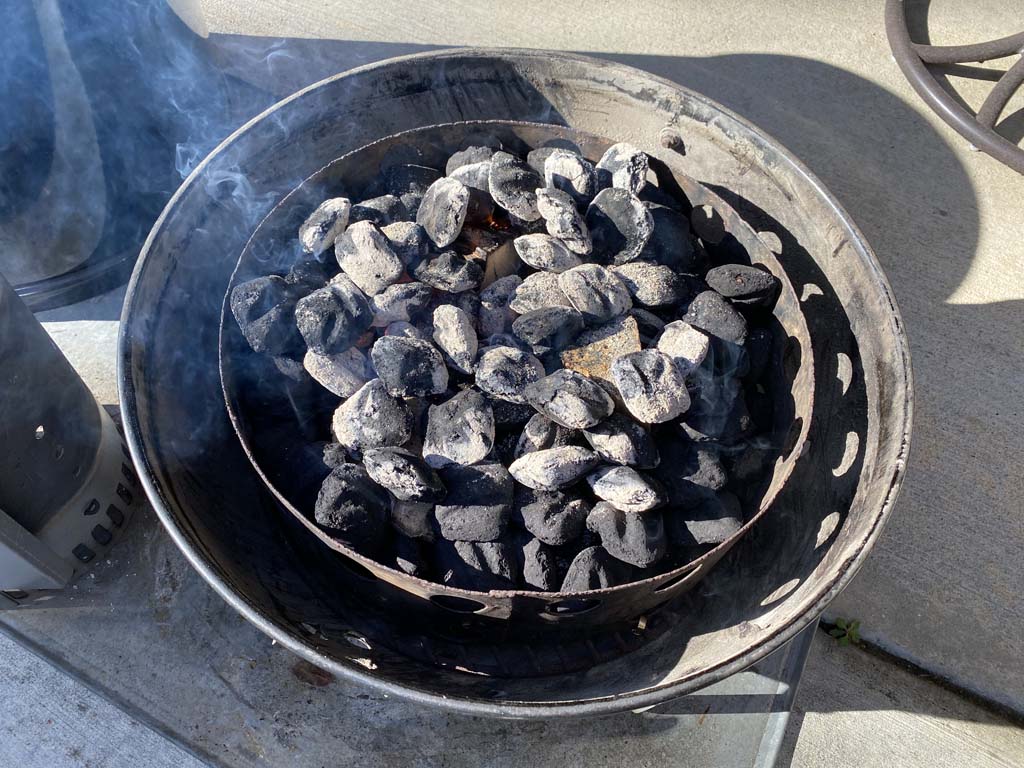
I don’t advocate the use of wood chips, because I think chunks burn longer and more evenly. However, some people put down a layer of charcoal in the bottom of the chamber, then a layer of wood chips, a layer of charcoal, and so on, until the chamber is filled to the top. Light using the Minion Method.
Visible Smoke: How Much & For How Long?
When you fire-up the Weber Smokey Mountain Cooker and add smoke wood to the hot coals, it’s common to see an initial flush of white smoke that lasts for 30-60 minutes as the wood ignites. After that, the amount of smoke decreases to where very little is visible. It’s at this point where many people wonder if the wood has been totally consumed and if they should add more.
You don’t need to see smoke billowing out of the WSM throughout the entire cooking process to get good smoke flavor on the meat. If you open the smoker after the initial 30-60 minutes of strong visible smoke, you may be surprised to see much of the wood still there, burning slowly and doing its job.
My advice: Trust that adding 2-4 chunks of smoke wood at the beginning of a cooking session will give you all the smoke flavor your want in your meat, regardless of how much smoke is visible during the cooking process.
Where To Buy
The best smoke wood is free smoke wood! Check with local orchards, golf courses and tree trimming services, especially after storms. Tell them that your hobby is barbecue, you’re looking for a few split pieces of wood, and they’re likely to give you some for free.
If you have to purchase smoke wood, it’s best to buy locally whenever possible because of the high cost of shipping.
Hickory and mesquite chunks are readily available at most hardware stores and home centers. Check Home Depot, Lowe’s, Orchard Supply Hardware, Ace, True Value, and other such stores. Better grocery stores will often have these products, too.
Hickory, mesquite, alder, apple, cherry, oak, and pecan can be purchased from Amazon.com and at specialty stores like Barbeques Galore and from suppliers such as Uncle Robby’s Great & Audacious Wood and Fruita Wood & BBQ Supply.
You can also find a number of other smoke wood suppliers listed on The Smoke Ring or by using this Google search.
Many of the “exotic” woods listed at the top of this page are not available through retail suppliers. Most people harvest these woods from trees on their own property or on a friend’s property, or purchase them from orchards and other property owners.
By The Bag, Box, Or Truckload
If you buy smoke wood at retail stores, it will probably come in paper or plastic bags in small quantities sold by weight or volume. This is convenient for those who live in urban areas without a lot of storage space and without access to cut trees or branches.
If you order smoke wood over the phone or Internet, you’ll probably have to buy a minimum quantity by weight, usually a 50 pound box or sack of wood. This is fine if you have storage space and the price of the wood is reasonable, but you’ll pay about as much in shipping as you will for the wood itself.
If you’re lucky enough to have appropriate smoke wood trees on your property, or know someone who does, you can chop up green logs and branches into chunks for use in your Weber Bullet. Most people let the wood season before use, but others will use a mix of green and seasoned wood chunks.