In This Topic
- Why You Should Let Meat Rest After Cooking
- How Resting Meat Works
- A 2-4 Hour Rest Makes Brisket & Pork Butt Better
- Holding Brisket Longer Than 4 Hours
- Carry-Over Cooking
- How Long Should Meat Rest?
- Cover Loosely With Foil…And When Not To
- Cooking Times & Temperatures
Why You Should Let Meat Rest After Cooking
In one of my earliest barbecue experiences, I took a brisket out of the Weber Smokey Mountain Cooker after it was cooked and sliced into it immediately. I was surprised to see a flood of juices run out across the cutting board, and when I ate the meat it seemed very dry.
My experience was an example of why it’s important to let meat rest after cooking. Allowing almost any meat to rest—whether thick steaks, thick chops, whole turkeys, briskets or pork butts—helps keep meat more moist and improves the texture & tenderness of meat.
How Resting Meat Works
Meat is muscle, and muscle consists of proteins, fat, vitamins & minerals, and water—lots of water. According to The Science of Good Cooking, raw beef is about 75 percent water. When meat is cooked, muscle fibers begin to compress and contract, which really puts the squeeze on water. In the book CookWise, author Shirley O. Corriher says that up to 120°F internal temperature, meat proteins shrink in diameter only and there is little moisture loss, but above 120°F the proteins also begin to shrink in length—up to half their original length—which forces moisture into the spaces between the muscle fibers and toward the surface and center of the meat. For very lean cuts of meat, like a chicken breast or a pork chop, by the time they reach 170°F internal temp, most of the moisture has been squeezed out, rendering them tough and dry. But for large, fatty cuts of meat that cook to 200-205°F internal temp, like a brisket or a pork butt, there’s lots of liquid under pressure that will flow out onto the cutting board if you don’t allow the meat to rest. You’ll also lose moisture in the form of steam that wafts away from the very hot meat as you cut into it.
When meat is allowed to rest after cooking, this process is partially reversed. As the meat fibers begin to relax, moisture that was driven out is redistributed and reabsorbed by some of the dissolved proteins. Rested meat holds on to more of its natural juices—they don’t flood the cutting board when you slice into the meat. And since our perception of tenderness is greatly affected by moisture content—moist meat is softer and perceived as being more tender than dry meat—the result is more succulent, tender meat.
How much moisture is lost when meat is not rested? America’s Test Kitchen Radio did an experiment in which they cooked pork loin roasts at 400°F to an internal temperature of 140°F. Here’s how much liquid each roast lost after different resting times:
| Resting Time | Amount Of Liquid Lost |
| 0 minutes | 10 Tablespoons |
| 10 minutes | 4 Tablespoons |
| 20 minutes | 2.5 Tablespoons |
| 30 minutes | 1 Tablespoon |
| 40 minutes | 2.5 teaspoons |
America’s Test Kitchen Radio, “A New Manifesto for School Lunch”, March 23, 2012
Just a 10 minute rest resulted in a 60% decrease in lost liquid, and a 40 minute rest resulted in a 90% decrease of lost liquid—and even after 40 minutes, the internal meat temperature was still hot enough to serve.
A 2-4 Hour Rest Makes Brisket & Pork Butt Better
Briskets and pork butts are commonly cooked to internal temps as high as 205°F, which drives a lot of moisture out of the meat. So why don’t these cuts get tough and dry? Because they contain connective tissue that is converted to gelatin after many hours of “low & slow” cooking, and it’s this gelatin that rehydrates the meat during the resting period. The gelatin also thickens a bit as the meat cools during the rest, so more of it stays in the meat when sliced or pulled.
Many competition barbecue teams will wrap briskets and pork butts in aluminum foil during the final stages of cooking and add broth, juice, or other flavorful concoctions to the foil package. When the meat has finished cooking, they allow it to rest in the foil in an empty cooler or insulated Cambro box for several hours where it reabsorbs some of the accumulated liquid before being sliced or pulled for presentation to the judges.
It’s been well documented that some of the best barbecue chefs in America like Aaron Franklin and Wayne Mueller wrap their briskets in butcher paper part way through the cooking process, and when finished hold them in insulated Cambro boxes or custom warming boxes for 2-4 hours or even longer before serving. “It took our quality index from a low A to a high A,” says Mueller. Jeff Savell, professor of meat science at Texas A&M University and an expert on brisket, says about restaurants holding barbecue for 2-4 hours, “My observation is that this rested barbecue…is the best ever produced.”
At home, you can rest briskets and pork butts just like barbecue competitors and restauranteurs. Place some towels in the bottom of an empty cooler to protect the plastic from the hot meat. Wrap the meat with more towels as insulation and place into the cooler. Monitor the meat temp to ensure it stays above 140°F for food safety. See Holding, Storing & Reheating Barbecued Meats for more details.
You may also be able to use your electric oven like a warming box to hold brisket at temp for long periods of time like restaurants do. See Using An Electric Oven To Hold Brisket At Temperature.
Holding Brisket Longer Than 4 Hours
If a 2-4 hour hold time is good, an even longer hold time must be better, right? Well, some people think so, as long as you keep the meat tightly wrapped to prevent it from drying out and keep precise control of the holding temperature.
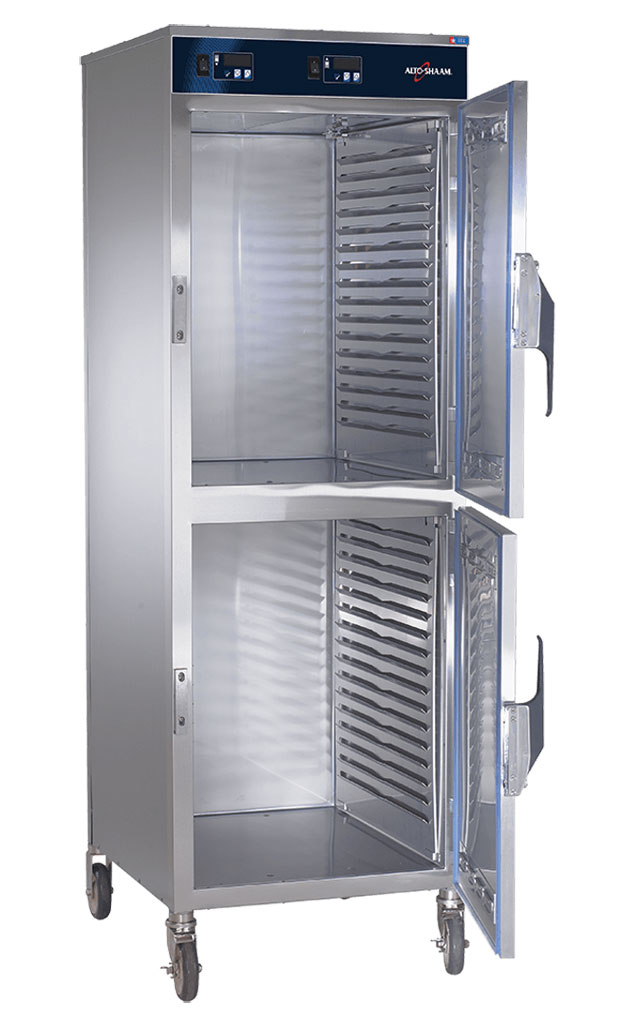
Some barbecue restaurants use professional warming boxes to hold brisket much longer than 2-4 hours, like the Alto-Shaam, a multi-shelved enclosure with a thermostatically controlled electric heating element that can maintain a low, steady temperature for hours on end.
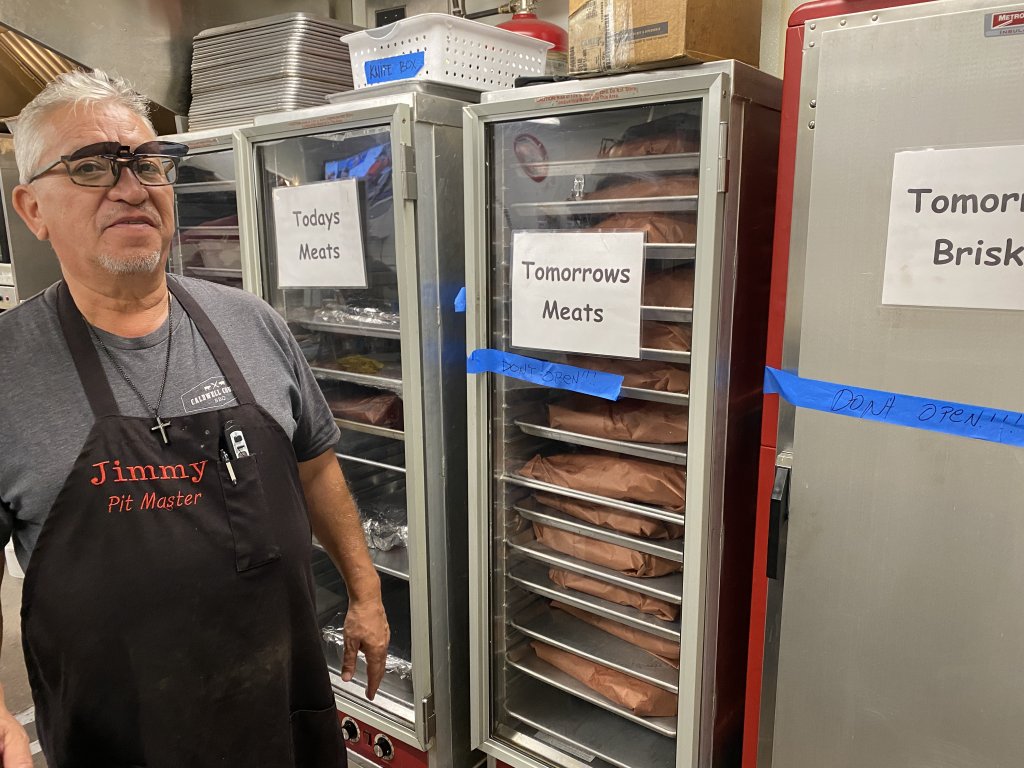
Pitmaster Jimmy Perez, Caldwell Country BBQ, Gilbert AZ
One such restaurant is Caldwell County BBQ in Gilbert, AZ, where pitmaster Jimmy Perez hold briskets at 170°F for 17 hours. Yes, you read that right. They put briskets into the pit at 6:00 am, take them out of the pit at 6:00 pm, and hold them at 170°F until they open for service the next day at 11:00 am.
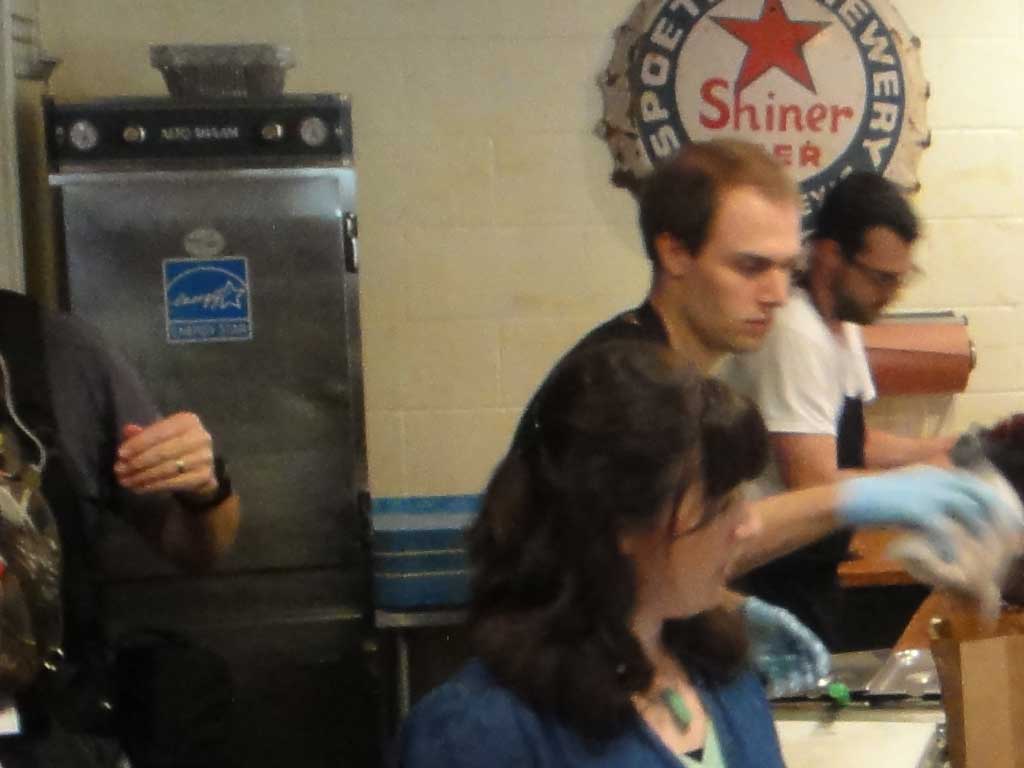
Another restaurant doing a long hold time on brisket is Franklin Barbecue in Austin, TX. In his book Franklin Barbecue: A Meat-Smoking Manifesto, pitmaster Aaron Franklin says he finishes cooking briskets at 2:00 am and serves them when the restaurant opens at 11:00 am. That’s a nine hour hold time, and it’s achieved with an Alto-Shamm warming box.
Carry-Over Cooking
Have you ever noticed that the internal temperature of meat continues to rise after removing it from the cooker, grill or oven? This is called carry-over cooking and is caused by residual heat transferring from the hotter exterior of the meat to the cooler center.
As a general rule, the larger and thicker the cut of meat, and the higher the cooking temperature, the more residual heat will be in the meat, and the more the internal temperature will rise during resting due to carry-over cooking. This means the meat must be removed from the heat at an internal temperature slightly lower than your desired final internal temperature, allowing the residual heat to finish the cooking.
How Long Should Meat Rest?
Most well-documented recipes on the Web and in cookbooks will specify the resting time, so follow the author’s advice. Otherwise, here are some guidelines for various meats.
Note that thin cuts of meat like ribs, chicken, fish, and thin steaks and chops need almost no time to rest after cooking. They just don’t have enough mass to hold a lot of residual heat, so there is little, if any, carry-over cooking, and if you let them rest too long, they’re cold! So for thin cuts of meat, the time it takes to get them off the grill and onto your dinner plate is enough of a resting period.
| Resting Time | Rise In Internal Temp | |
| Chicken, pieces Barbecued at 225-250°F Roasted at 350°F |
. 0 minutes 0 minutes |
. 0°F 0°F |
| Chicken, butterflied or whole Barbecued at 225-250°F Roasted at 350°F |
. 0 minutes 5 minutes |
. 0°F 0-5°F |
| Turkey, whole Barbecued at 225-250°F Roasted at 350°F |
. 20-30 minutes 20-30 minutes |
. 0-5°F 5-10°F |
| Pork ribs, spares or loin back Barbecued at 225-250°F |
. 0 minutes |
. 0°F |
| Pork butt Barbecued at 225-250°F Finished in a 300°F oven |
. 2-4 hours 2-4 hours |
. 0-5°F 5-10°F |
| Brisket Barbecued at 225-250°F Finished in a 300°F oven |
. 2-4 hours 2-4 hours |
. 0-5°F 5-10°F |
| Rib roast (prime rib) Roasted at 325-350°F |
. 15-30 minutes |
. 10-15°F |
| Steaks, thin chops** Grilled over high heat |
. 0-5 minutes |
. 5°F |
| Thick chops, small roasts** Grilled over high heat |
. 10-15 minutes |
. 5-10°F |
** From Cook’s Illustrated magazine, July/August 2004
For example, when roasting a prime rib at 325°F and targeting a final internal temperature of 135°F, remove the meat from the fire at 120-125°F, cover loosely with foil, and let rest for about 15 minutes. The roast will rise to your final internal temp during the rest.
Cover Loosely With Foil…And When Not To
During the resting period, cover meat loosely with aluminum foil to prevent the surface from cooling off too fast. Make sure the meat is on a cutting board with a “gravy groove” or a rimmed baking sheet pan to catch any juices. An exception to this rule is chicken or turkey…if you’ve worked hard to achieve crispy skin, covering with foil will soften the skin, so do not cover these with foil. And of course, if you plan to hold brisket or pork butt for several hours in an empty cooler, you will want to wrap these tightly with foil. See Holding, Storing & Reheating Barbecued Meats for more details.
Cooking Times & Temperatures
If you’re looking for some general guidelines for cooking times and internal temperatures for various meats, see Cooking Times & Temperatures.