In This Topic
- What Is Ham?
- Curing Ingredients
- Wet And Dry Curing (City Ham And Country Ham)
- Ham Cuts: Whole, Half, Bone-In, Boneless, Butt, Shank
- Which Ham To Buy?
- Natural Juices, Water Added, And Water Product
- Spiral-Sliced Hams
- “Ready To Eat” vs. “Ready To Cook”
- How Much Ham Should I Buy?
- Serving Temperature
- Cooking Ham On The Weber Bullet
- Carving A Ham
- Storage
- Nutrition
- Ham Do’s And Don’ts
- Glossary Of Ham Terms
- More Ham Links On TVWB
What Is Ham?
Ham comes from the hind leg of the hog. Ham can be fresh, cured or cured and smoked. Fresh ham is pale pink, just like pork butt, and beige in color after cooking. Cured ham is usually deep pink in color as a result of the curing process. Dry-cured ham like country ham and prosciutto is pink to mahogany in color.
The cured and smoked picnic portion of the front shoulder is sometimes called “picnic ham”. This is not true ham. Remember, ham is a cut of meat from the hind leg, not the process of curing and smoking the meat. While tasty, picnic ham has a higher proportion of fat, bone and skin to lean meat and is therefore much less expensive than real ham.
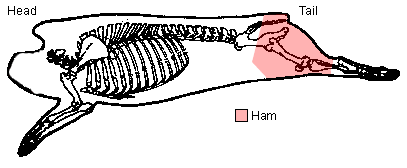
Location of ham on the hog
Curing Ingredients
Hams are cured using a combination of salt, sodium nitrate, nitrites, sugar, seasonings, and other ingredients for preservation, color development and flavor enhancement. Sodium nitrate and nitrites give ham its distinctive flavor and color, while the nitrites and salt inhibit the growth of Clostridium botulinum, a cause of food poisoning.
Wet And Dry Curing (City Ham And Country Ham)
The three most common types of ham in the United States are fresh ham, city ham and country ham. Fresh ham is not cured and can be cooked like any other cut of fresh pork. The difference between city ham and country ham has to do with the way in which it is cured.
Wet curing is the most popular method for curing ham. Traditionally, a fresh ham was soaked in a liquid curing solution for a couple of weeks so that the cure could penetrate the meat. Today, fresh hams are injected with a curing solution and cure in just a day or two. After the ham is cured, it is usually smoked. The result is a “city ham”, a moist, juicy ham like the ones you find in the supermarket. This is the kind of ham you should choose for preparation on the Weber Bullet.
Dry curing is the process used to make “country ham” like the famous Smithfield ham from Virginia. A country ham starts out as a fresh ham that is rubbed with a dry cure mixture, smoked in a smokehouse, then aged at 75-80°F or higher in rooms or barn-like structures for a period of a few months to more than a year.
A country ham will lose 20-30% of its moisture content during aging. Mold develops on the surface during this time and must be washed away before the ham undergoes a long soaking and simmering process before baking. The result is firm, dry meat with a very concentrated, salty flavor and a deep burgundy color. While delicious, it is something of an acquired taste.
Given that they’re so expensive, can be hard to come by, and have been lovingly smoked and cured for up to a year, I don’t recommend that you barbecue a country ham in the Weber Bullet. However, there are differing opinions on this matter. Jim Minion of Minion Method fame says that country hams can be smoked with hickory, pecan, or fruitwood. “The thing that needs to be done to get the best results is to soak in fresh water for a couple of days, changing the water 3-4 times during that time. Smoke to 160°F internal in the center of the ham. Very good eating.”
The United States also imports a wide variety of dry-cured hams from other countries, including prosciutto, Spanish Serrano ham, Bayonne ham, Black Forest ham and Westphalian ham. These are similar to country ham except that they’re often eaten raw, while country ham is baked before serving.
Ham Cuts: Whole, Half, Bone-In, Boneless, Butt, Shank
Hams are available bone-in or boneless. Most people feel that bone-in hams are more flavorful and have better texture than boneless hams. Bone-in hams will have part of the leg bone or hipbone intact, plus some smaller bones depending on the cut. Boneless hams have had all the bones removed and are then bound up and tumbled in order to fill any voids in the meat. Boneless hams are easy to carve, of course, but a spiral-sliced, bone-in ham is probably a better choice since it combines better flavor with ease of serving.
You’ll want to buy a ham of appropriate size based on the number of people you want to serve. You can purchase a whole ham (pretty much the entire leg of the hog) that will feed an army, or you can buy a half ham. Half hams come in two varieties: the butt end and the shank end. The butt end comes from the upper thigh and has a rounded end, whereas the shank end comes from the lower portion of the leg and has a pointed or tapered end.
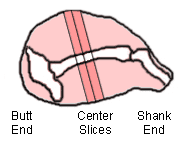
Half ham varieties and center slices
Sometimes the best “center cut” slices are removed from half hams during processing. If the label on a half ham reads “shank end half” or “butt end half“, then it includes these meaty center slices. If it says “shank end portion” or “butt end portion“, then the center slices have been removed.
Which Ham To Buy?
When choosing a whole, bone-in ham, authors Bruce Aidells and Denis Kelly of The Complete Meat Cookbook write, “A short, plump shape with a stubby rather than an elongated shank is the best choice.”
When choosing a half ham, the butt end is meatier and less fatty than the shank end. However, the shank end is easier to carve because of its simple bone structure. Both are good choices, but shank end is preferred.
Natural Juices, Water Added, And Water Product
You’ll see references to “juices” or “water” on the label of a ham. Here’s how they’re defined by the USDA:
Ham: the product is at least 20.5% protein in lean portion and contains no added water. For example, a country ham.
Ham with Natural Juices: the product is at least 18.5% protein. Can weigh 8% more than uncured weight. (This kind of ham should be your first choice for cooking on the WSM. Some spiral-sliced bone-in hams fall into this category.)
Ham—Water Added: the product is at least 17% protein with 10% added solution; it can weigh 8% more after curing than uncured weight. (This is your second best choice for cooking on the WSM. Many supermarket hams and some spiral-sliced hams fall into this category.)
Ham And Water Product: product may contain any amount of water but the label must indicate percent of “added ingredients.” For example, “X% of weight is added ingredients” for any canned ham with less than 17% protein.
A ham with more water content will be a less expensive product, but that also means you’re paying for a lot of water instead of meat.
Spiral-Sliced Hams
Spiral slicing is a process in which a ham is placed on a special cutting machine that spins the ham around while cutting thin slices all the way to the bone in a continuous spiral. They are usually served with a sweet glaze of some sort. These hams have become extremely popular in recent years because of their serving convenience.
Almost all spiral-sliced hams are bone-in, and some are a “ham with natural juices” product, meaning they’re of better quality and flavor. You can buy whole spiral-sliced hams at specialty shops like HoneyBaked Ham, but you’re likely to find only half hams at the supermarket or wholesale warehouse store.
Spiral-sliced hams usually include a separate glaze packet. You can skip the glaze, use the glaze packet, or make your own. You’ll find a glaze recipe on the Whole Ham – Mustard & Whiskey Glazed page.
“Ready To Eat” vs. “Ready To Cook”
Most hams that you find at the supermarket are already cooked and can be eaten right out of the package. These include fully-cooked hams, spiral-sliced hams and canned hams. Look for the phrase “ready to eat” on the label.
Fresh hams and hams that have only been partially cooked must be fully cooked to 145-150°F internal temperature so that they achieve a final resting temperature of 155-160°F before serving. Look for the phrase “ready to cook” or “cook before eating” on the label. The USDA safe food handling instructions will also be found somewhere on the label of this kind of ham.
How Much Ham Should I Buy?
Recommendations vary as to how much ham to buy.
- HoneyBaked Ham Company offers the following charts:
| Half Ham | 7-8 lbs | 8-9 lbs | 9-10 lbs |
| Dinner Serves: | 10-14 | 14-16 | 16-18 |
| Buffet Serves: | 16-20 | 21-24 | 25-28 |
| Whole Ham | 12-14 lbs | 14-16 lbs | 16-18 lbs |
| Dinner Serves: | 22-26 | 26-30 | 30-34 |
| Buffet Serves: | 33-40 | 40-45 | 45-52 |
- Cook’s Illustrated magazine estimates that you’ll get 3-4 servings per pound of bone-in ham. “Most half hams range in size from 7-10 pounds, serving 20-30.”
- Martha Stewart says, “A 16-pound ham can feed 18-20 people (estimate about 3/4 pound per person for a bone-in ham and 1/2 pound for boneless).”
- Bruce Aidells and Denis Kelly write that a whole ham weighing 10-20 pounds “will serve 20 people, probably with leftovers. A 6-to-8 pound shank (end) will serve 10 to 12 people, a 6-to-8 pound butt (end) 12 or more.” They go on to say, “allow 8 to 12 ounces for a bone-in ham per serving, 6 to 8 ounces for a boneless ham.”
- The USDA recommends 1/4 to 1/3 pound of boneless ham per serving, 1/3 to 1/2 pound of meat per serving of ham with little bone, and 3/4 to 1 pound of meat per serving of ham with large bone.
Serving Temperature
Most people agree that ham should be served warm or cool—but definitely not cold right out of the refrigerator. For a “ready to eat” ham, a range of 110-140° seems to be the consensus. “Ready to cook” hams must be fully cooked to 145-150°F internal temperature so that they achieve a final resting temperature of 155-160°F before serving.
Cooking Ham On The Weber Bullet
“Ready to eat” and “ready to cook” city hams are easily prepared using the WSM.
- Trim the fat layer to 1/4″ and score the fat into a diamond pattern, cutting 1/4″ to 1/2″ deep into 1″ to 2″ squares.
- For a “ready to eat” ham, fire the cooker to 225-250°F. Add some water to the water pan to keep the temperature down and put 2-3 dry chunks of your favorite smoke wood on the coals. Apple, cherry, alder and oak are good choices alone or in combination. Follow the packaging instructions for how to arrange the ham in the cooker (for example, spiral-sliced hams are usually placed with the cut side down on a rimmed baking sheet pan). Heat the ham to an internal temperature of 110-140°F. If desired, apply a glaze toward the end of the process.
- For a “ready to cook” ham, fire the cooker to 325°F. Put the foil-lined water pan in place, but leave it dry to keep the temperature up in the cooker. Place 2-3 chunks of dry smoke wood on the coals and cook according to the packaging instructions, usually 10-15 minutes per pound. If desired, apply a glaze during the last hour of cooking. Cook to 145-150°F internal temperature, then allow the ham to rest 15-20 minutes until it reaches a final temperature of 155-160°F.
Carving A Ham
Here’s how to carve a whole ham:
- Cut a few thin slices from the side of the ham that is rounder in order to make a flat base.
- Stand the ham on the cut side and slice straight down to the bone in 1/4″ slices.
- Run the knife horizontally along the bone to remove the slices.
- Turn the ham over and carve 1/4″ slices in the same fashion.
To carve a half ham, follow the steps above for a whole ham, but don’t bother cutting a flat base on the side.
To carve a spiral-sliced ham, just follow the instructions included with the ham. Otherwise, follow the steps illustrated below:
- Use the tip of a sharp knife to cut around the bone to loosen the slices.
- Use a long carving knife to cut horizontally through the top spiral slices, starting at the outside edge of the ham and cutting all the way to the bone. Follow the natural muscle lines for good looking slices.
- Remove the top slices from the bone and cut to fully separate the slices.
- Cut straight down from the bone to release the remaining slices.
- Cut away any meat in areas that have not been spiral sliced.
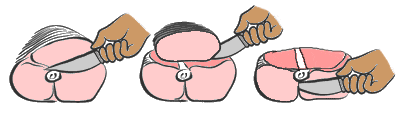
Carving a spiral-sliced ham
Storage
For the most part, all hams must be refrigerated before and after serving. The exceptions are some small canned hams (better quality canned hams from Denmark and Holland must be kept refrigerated—read the label) and country hams, which may be stored unrefrigerated in a cool, dark location almost indefinitely. A country ham contains so little water that bacteria have a hard time surviving, so the meat doesn’t spoil easily.
According to the USDA:
- Fresh, uncured ham can be safely refrigerated for 3-5 days before cooking and 3-4 days after cooking.
- Cured “ready to cook” ham can be refrigerated 5-7 days before cooking or until the “use by” date on the package, then refrigerated 3-5 days after cooking.
- Fully cooked, “ready to eat” ham in a store wrapping (e.g. HoneyBaked Ham loose foil wrapper) can be refrigerated up to 7 days for a whole ham and 3-5 days for a half ham.
- Fully cooked vacuum sealed ham can be refrigerated for up to two weeks if undated and unopened or until the “use by” date, then 3-5 days after being opened.
- Whole, uncut country hams can be stored safely at room temperature for up to 1 year. After 1 year the ham is safe but quality may suffer. It may be refrigerated for up to 3 months before cooking, then refrigerated for up to 7 days after cooking.
- Canned hams labeled “Keep Refrigerated” can be refrigerated from 6-9 months, then refrigerated up to 7 days after opening.
- “Shelf stable” canned hams may be stored at room temperature for up to 2 years, then refrigerated 3-4 days after opening.
Ham remains safe indefinitely when frozen, but texture and taste will suffer after about 2 months.
Nutrition
Ham is one of the leanest cuts of pork. According to the USDA, a 3.4 ounce (100 gram) serving of roasted extra-lean ham has about 145 calories, 5.5 grams of fat, 21 grams of protein and 53 milligrams of cholesterol. Ham contains a significant amount of vitamins B-1 and B-12.
While fresh pork is low in sodium, ham is high in sodium as a result of the curing process. According to the USDA, a serving of ham can contain about one-half of the recommended daily intake of sodium.
Ham Do’s And Don’ts
- Do trim the fat, leaving a 1/4″ layer. Score the fat into a diamond pattern by cutting 1/4″ to 1/2″ deep into 1″ to 2″ squares. Not only does scoring look nice, but it allows fat to render from the ham and provides greater surface area for the glaze to stick to. You may not be able to score a ham that has been “super trimmed” and has little fat left.
- Do use a sharp carving knife with a thin blade to cut the ham, or buy a spiral-sliced ham.
- Don’t forget to line your WSM water pan with aluminum foil if cooking a ham at high temperature and with an empty water. Cleanup will be much easier.
- Don’t baste the ham with its drippings during cooking, as they tend to be too salty.
- Don’t coat the ham with sugar, honey or glaze until the last hour of cooking. One application is usually enough.
- Don’t throw out the ham bone, use it to flavor soups or bean dishes.
Glossary Of Ham Terms
Here’s a list of terms that you may encounter when shopping for ham:
Ardennes Ham: An air-dried ham similar to prosciutto.
Bayonne Ham or Jambon Bayonne: A boneless French ham similar to prosciutto.
Black Forest Ham: A moist German ham that is smoked and coated with beef blood to create a black exterior.
Butt End, Half or Portion: The upper, meatier part of the whole leg; a butt portion has had some center slices removed for separate sale as ham steaks or center cut ham slices. The half includes this meat.
Canned Ham: Canned hams come in two forms:
- Shelf stable – store on shelf up to 2 years at room temperature. Generally not over 3 pounds in size. Processed to kill all spoilage bacteria and pathogenic organisms such as Clostridium botulinum, Salmonella and Trichinella spiralis. The product is free of microorganisms capable of growing at ordinary room temperature. However, high temperature storage — above 122°F F (50°F C) — may result in harmless thermophylic bacteria multiplying and swelling or souring the product.
- Refrigerated – may be stored in refrigerator up to 6 to 9 months. Its weight can be up to 8% more than original uncured weight due to uptake of water during curing. It need not be labeled “Added water” except for “In Natural Juices.” Net Weight is the weight of the actual ham excluding the container. Processed at a time/temperature sufficient to kill infectious organisms (including Trichinae) but the ham is not sterilized so spoilage bacteria may grow eventually.
Capacolla: Boneless pork butt which is dry cured; not necessarily cooked. Ham capacolla is made with ham instead of pork butt.
Cook Before Eating: Needs further cooking. Is not completely cooked in the plant and should be cooked to 160°F F.
Cottage Ham: A ham made from the shoulder butt end.
Country Ham: Uncooked, cured, dried, smoked-or-unsmoked meat products made from a single piece of meat from the hind leg of a hog or from a single piece of meat from a pork shoulder. Smithfield and country hams are not fully cooked but are dry cured to be safe stored at room temperature. They should be cooked before eating according to manufacturer’s instructions. A ham labeled “Smithfield Ham” must be processed in the city of Smithfield, Virginia.
Fresh Ham: The uncured leg of pork. Since the meat is not cured or smoked, it has the flavor of a fresh pork loin roast or pork chops. Its raw color is pinkish red and after cooking, grayish white.
Fully Cooked: Needs no further cooking. Fully cooked in plant. Can be eaten directly as it comes from its packaging or reheated.
Gelatin: About one-fourth ounce of dry gelatin is often added before a canned ham is sealed to cushion the ham during shipment. During processing, natural juices cook out of the ham and combine with the gelatin. When the ham cools, a jell forms. Gelatin is included in the net weight statement on the label.
Ham: The product is at least 20.5% protein in lean portion and contains no added water.
Ham with Natural Juices: The product is at least 18.5% protein. Can weigh 8% more than uncured weight. Example: canned hams.
Ham—Water Added: The product is at least 17.0% protein with 10% added solution; it can weigh 8% more after curing than uncured weight.
Ham and Water Products: Product may contain any amount of water but label must indicate percent of “added ingredients.” For example, “X % of weight is added ingredients” for any canned ham with less than 17.0% protein.
Ham Hocks: Portions of the lower leg, cut into pieces and smoked. Often used to flavor stews and other dishes.
Ham Steak: Another name for center cut ham slices.
Hickory-Smoked Ham: A cured ham which has been smoked by hanging over burning hickory wood chips in a smokehouse. May not be labeled “hickory smoked” unless hickory wood has been used.
Hock End or Hock Half: Same as a shank end half ham.
Honey-Cured: May be shown on the labeling of a cured product if honey is the only sweetening ingredient or is at least half the sweetening ingredients used, and if the honey is used in an amount sufficient to flavor and/or affect the appearance of the finished product.
“Lean” Ham: The term “lean” may be used on a ham’s label provided the product contains less than 10 grams fat, 4.5 grams or less of saturated fat, and less than 95 milligrams cholesterol per 100 grams and Reference Amount Customarily Consumed (RACC).
“Extra Lean” Ham: A ham labeled “extra lean” must contain less than 5 grams fat, less than 2 grams saturated fat and the same cholesterol as allowed per the amount of “lean” ham.
Picnic, Pork Shoulder Picnic: A front shoulder cut of pork which has been cured in the same manner as ham.
Prosciutto Ham: An Italian-style dry-cured raw ham; not smoked; often coated with pepper. Prosciutto can be eaten raw because of the way they are processed. Parma Ham is prosciutto from the Parma locale in Italy. These hams tend to be larger than the U.S. produced product, as Italian hogs are larger at slaughter.
Pumped Ham: Same as a wet cured ham.
“Sectioned and Formed” or “Chunked and Formed”: A boneless ham that is made from different cuts, tumbled or massaged and reassembled into a casing or mold and fully cooked. During this process it is usually thoroughly defatted.
Serrano Ham: A Spanish dry-cured ham that is not smoked and does not require cooking before eating. Similar to prosciutto.
Shank End, Half or Portion: The lower, slightly pointed part of the leg. A “portion” has the center slices removed for separate sale as “ham steaks” or center cut ham slices. The half includes this meat.
Skinless, Shankless: A ham with all of the skin and the shank removed. The leg bone and aitch (hip) bone remain.
Spiral-Sliced Ham: A ham that has been placed on a special cutting machine that spins the ham around while cutting thin slices all the way to the bone in a continuous spiral. Usually served with a sweet glaze.
Sugar Cured: A term that may appear on ham labels if cane or beet sugar is at least half the sweetening ingredients used and if the sugar is used in an amount sufficient to flavor and/or affect the appearance of the finished product. Most hams contain sugar in the curing mixture.
Tasso: A heavily smoked ham with a spicy pepper exterior. Common in Cajun cooking.
Westphalian Ham: A German-style dry-cured ham that is similar to prosciutto; smoked, sometimes with juniper berries. Also called Westfalischer Schinken.
York Ham: A dry-cured, lightly smoked British ham. Saltier but milder than most European hams.