Summary
- Buy a whole, partially-cooked or “ready to cook” ham.
- Score the fat side of the ham into 1″ to 2″ squares, about 1/4″ to 1/2″ deep.
- Cook at 325-350°F for 10-15 minutes per pound.
- Apply glaze 60-75 minutes before the end of cooking.
- Remove ham from cooker when it reaches an internal temperature of 155°F.
- Cover loosely with foil and let rest 30 minutes before carving. Residual heat will bring ham to a finished internal temp of 160°F.
 Note: I originally published this article in December 2001. It’s now April 2017 and it’s been years since I’ve seen a partially cooked or “ready to cook” ham in the supermarket. I guess consumers voted with their wallets for “ready to eat” hams over “ready to cook” hams. In any event, this recipe stands ready to help if you ever stumble across a “ready to cook” ham, and the mustard & whiskey glaze would be good on any ham.
Ham has been an Easter, Thanksgiving and Christmas favorite in my family throughout the years. However, you can enjoy ham any time of the year, as this topic illustrates.
The ham shown in this topic is a whole, partially cooked ham, sometimes called a “ready to cook” ham. Unlike fully cooked hams that are simply warmed to 110-140°F before serving, a partially cooked ham must be fully cooked to 145-150°F internal temperature so that it achieves a final resting temperature of 155-160°F before serving.
Partially cooked hams are not as common in supermarkets as they once were, but if you come across one, you might want to try smoking it as shown here.
To learn more about the various types of ham and ham terminology like “shank end”, “ham—water added” and “ready to eat”, see the Ham Selection & Preparation page.
Here are some pictures I took on May 26, 2001 when I smoked a whole, partially cooked ham on the Weber Bullet and finished it with a mustard and whiskey glaze.
Preparing The Ham
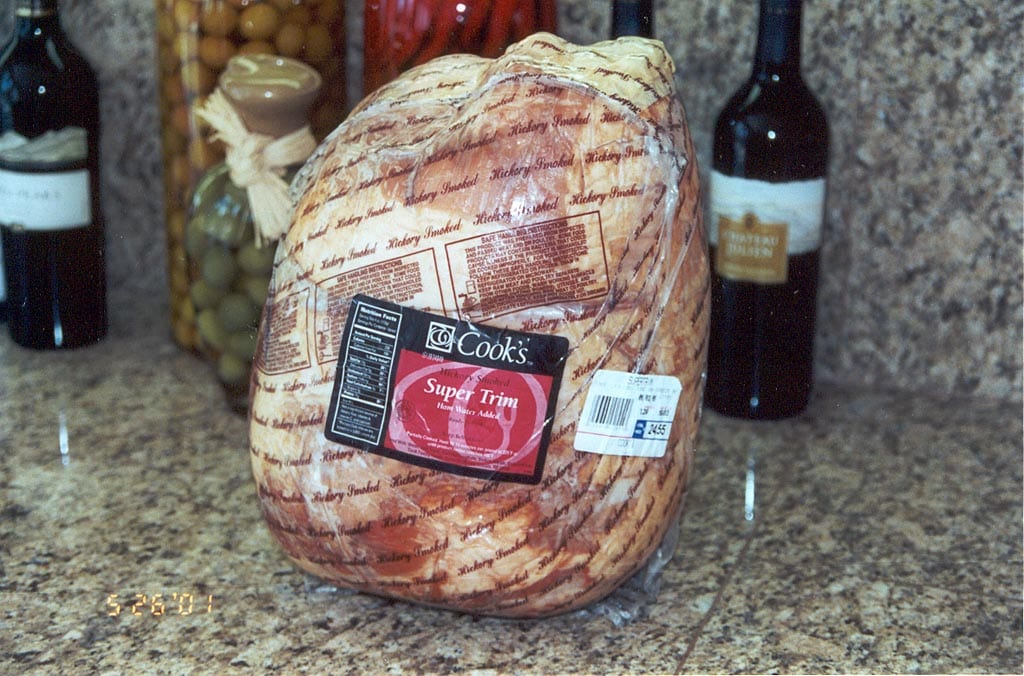 The ham shown here is a Cook’s Hickory Smoked Super Trim Whole Ham with “water added”. It’s the kind of whole ham you’re likely to find in the grocery store. The label says the ham is “ready to cook”, meaning that it’s been partially cooked and must be fully cooked to 160°F before serving. It weighed 19.03 pounds.
When you unwrap a ham like this one, you may find a jelly-like layer on the surface. Rinse it off under cold water and pat dry with paper towels.
Most whole hams you’re likely to buy at the store are well trimmed, so you won’t have to trim off any fat. If you buy a ham with the rind and fat intact, remove the rind and trim the fat to 1/4″.
Some hams won’t have enough fat on them to allow for scoring, but if your ham does, use a sharp knife to score the fat in the traditional diamond pattern before cooking. Cut the fat side 1/4″ to 1/2″ deep into 1″ to 2″ squares. This is done in part for aesthetics, but it also helps to render the fat during cooking and helps more glaze stick to the ham when applied during the last hour of the cook.
Finally, allow the ham to sit at room temperature for 2 hours before cooking.
Making The Glaze
This glaze combines ingredients from several recipes I found on the Internet…but the addition of Gentleman Jack was a spur of the moment decision on my part!
Mustard & Whiskey Glaze
- 1-1/4 cup dark brown sugar, packed
- 1/4 cup Dijon mustard
- 1/4 teaspoon ground clove
- 1/4 teaspoon ground cinnamon
- 1/4 teaspoon ground nutmeg
- 1/8 teaspoon ground allspice
- 2 Tablespoons Gentleman Jack Tennessee Whiskey
Combine ingredients and mix thoroughly into a thick paste.
Set the glaze aside in an airtight container. You won’t be needing it until the last hour of cooking.
Running The WSM Hot
 The package instructions for this ham read, “Cook at 325°F for 10-15 minutes per pound to 160°F internal.” For this 19 pound ham, that means a cooking time of 3 hours, 10 minutes to 4 hours, 45 minutes.
So to cook a ham of this size, you’ll need to maintain a temperature of 325-350°F for about 5 hours. This means running the Weber Bullet with a full chamber of fully-lit charcoal and no water in the water pan.
I began the process at 1:20pm by firing-up a Weber chimney starter full of Kingsford Charcoal Briquets. Within 30 minutes the coals were hot and I dumped them into the charcoal chamber and spread another full chimney of unlit briquettes over the lit coals. In retrospect, I should have filled the ring all the way to the top. As it turned out, I began to run out of fuel during the last hour of the cook and had to stir the coals and add more fuel.
At 2:10pm I assembled the cooker. I put the foil-lined water pan in place, but left if empty. I set all the bottom vents at 50% and left the top vent wide open.
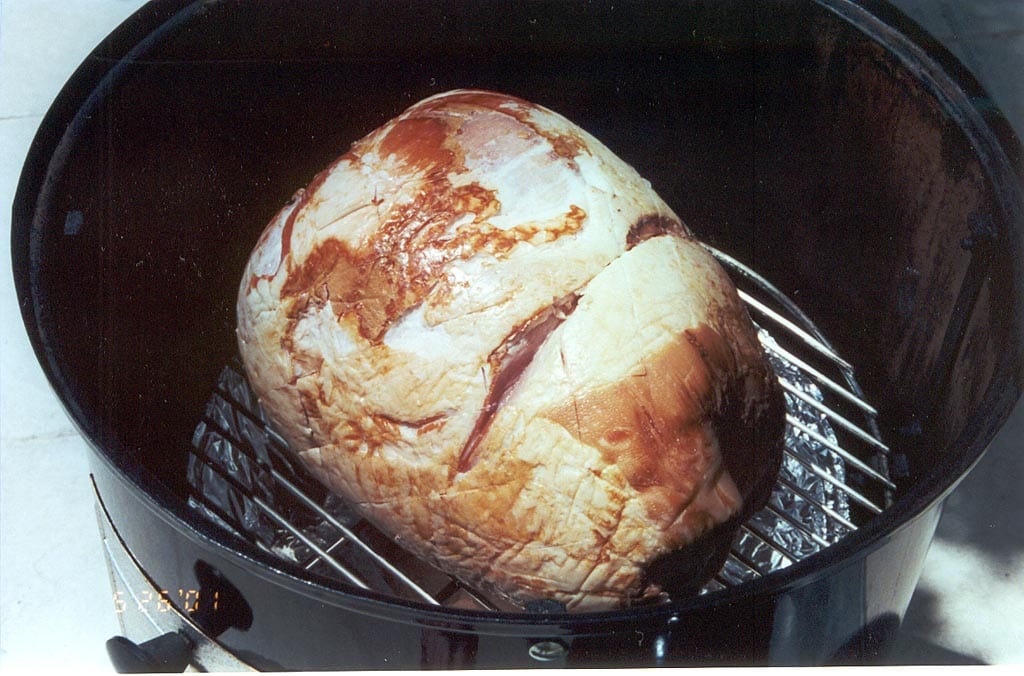
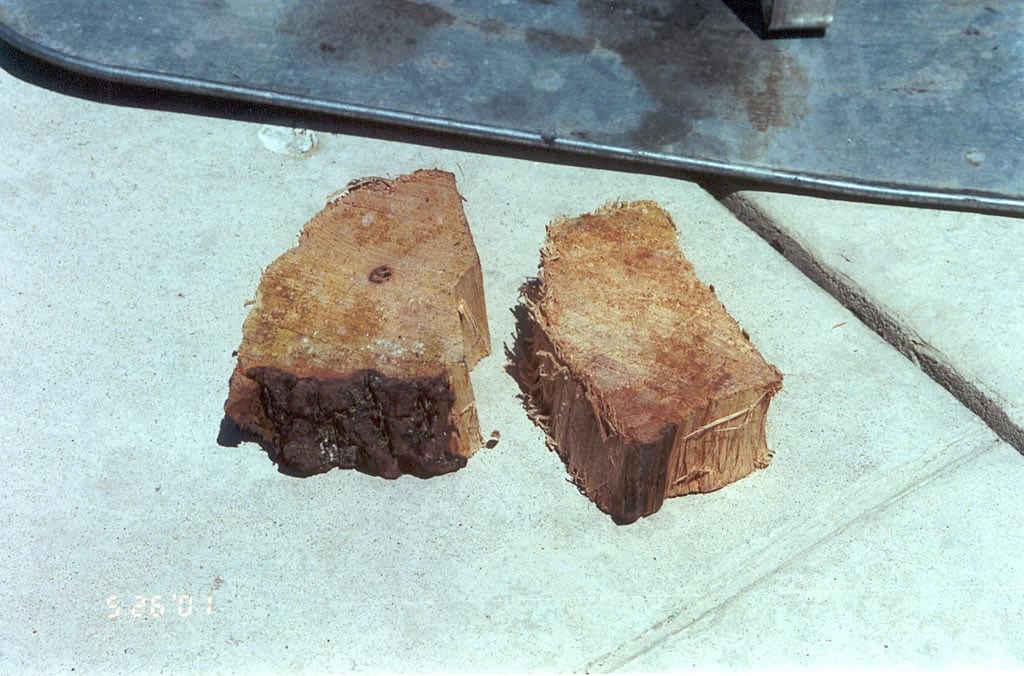 At 2:15pm the cooker registered 425°F. I put the ham on the bottom grate of the cooker (it was too large for the top grate, bumping into the lid thermometer) and added 2 large chunks of unsoaked apple smoke wood to the fire. Within 30 minutes, the cooker dropped to 300°F, so I opened all the bottom vents fully to bump the temperature up into the 325°F range.
Details Of The Cook
The plan for this ham was simple: Run the cooker at 325°F until the ham registered 155°F, adding the glaze during the last hour of cooking. Residual heat would bring the ham up to 160°F during a 30 minute resting period before carving. No turning, no basting, no water in the pan, and just the single application of smoke wood at the beginning of the cook.
Here’s how the cooker and meat temperatures went during what turned out to be a five hour cook. (I did not insert the probe thermometer into the ham until two hours into the cook, which explains the lack of internal temps prior to that point.)
| Time | Lid Temp | Meat Temp | Vent 1 % | Vent 2 % | Vent 3 % |
| 2:15 pm | 425 | – | 50 | 50 | 50 |
| 2:30 pm | 316 | – | 100 | 50 | 50 |
| 2:45 pm | 300 | – | 100 | 100 | 50 |
| 3:00 pm | 327 | – | 100 | 100 | 50 |
| 3:15 pm | 330 | – | 100 | 100 | 50 |
| 3:45 pm | 337 | – | 75 | 75 | 50 |
| 4:15 pm | 330 | 86 | 75 | 75 | 50 |
| 4:45 pm | 341 | 98 | 75 | 75 | 50 |
| 5:15 pm | 329 | 111 | 100 | 100 | 100 |
| 5:30 pm (s) | 335 | 116 | 100 | 100 | 100 |
| 6:00 pm (f)(g) | 317 | 129 | 100 | 100 | 100 |
| 6:30 pm | 308 | 140 | 100 | 100 | 100 |
| 7:00 pm | 306 | 149 | 100 | 100 | 100 |
| 7:15 pm | 320 | 154 | 100 | 100 | 100 |
(s) stirred coals
(f) added 15 unlit briquettes to the fire
(g) applied glaze to ham
Note that the vent percentages represent the way I set the vents at the time indicated.
You can see that I added 15 unlit briquettes to the fire at 6:00pm, but they didn’t do anything to increase the heat in the cooker until sometime after 7:00pm. I should have lit them before adding them to the fire.
Whole Ham At The Halftime
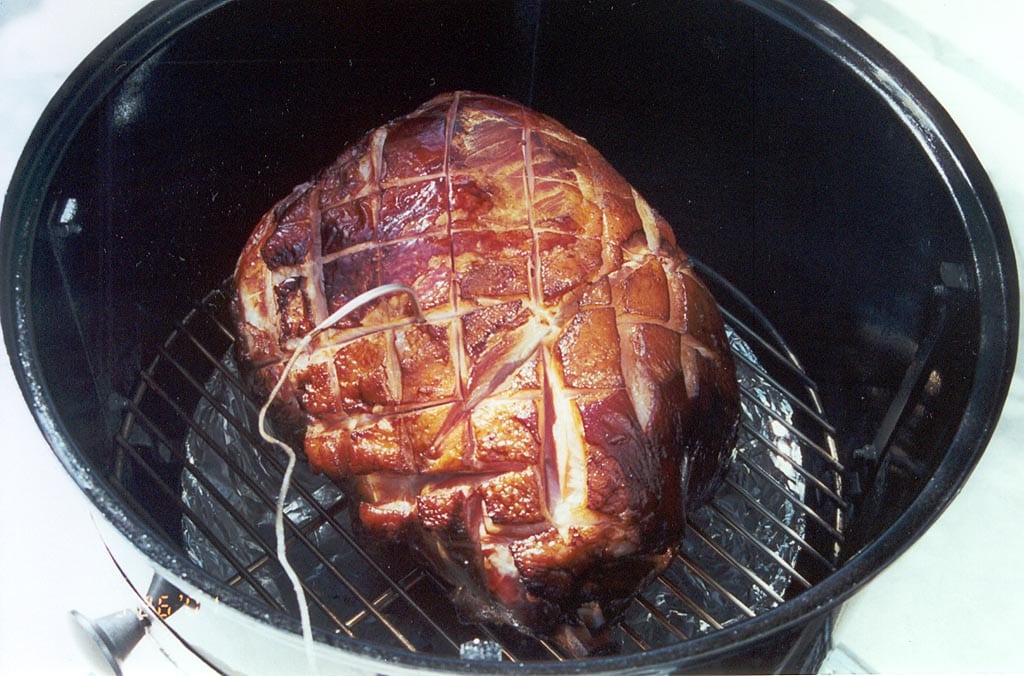 This photo shows how the ham looked at 4:15pm after 2 hours of cooking. At this point I inserted the probe thermometer into the center of the ham. Somehow I got distracted and forgot to do this step when I initially put the ham into the cooker.
At 4:45pm I noticed the sound and smell the pork fat sizzling in the empty foil-lined water pan. In my opinion, there’s no better aroma!
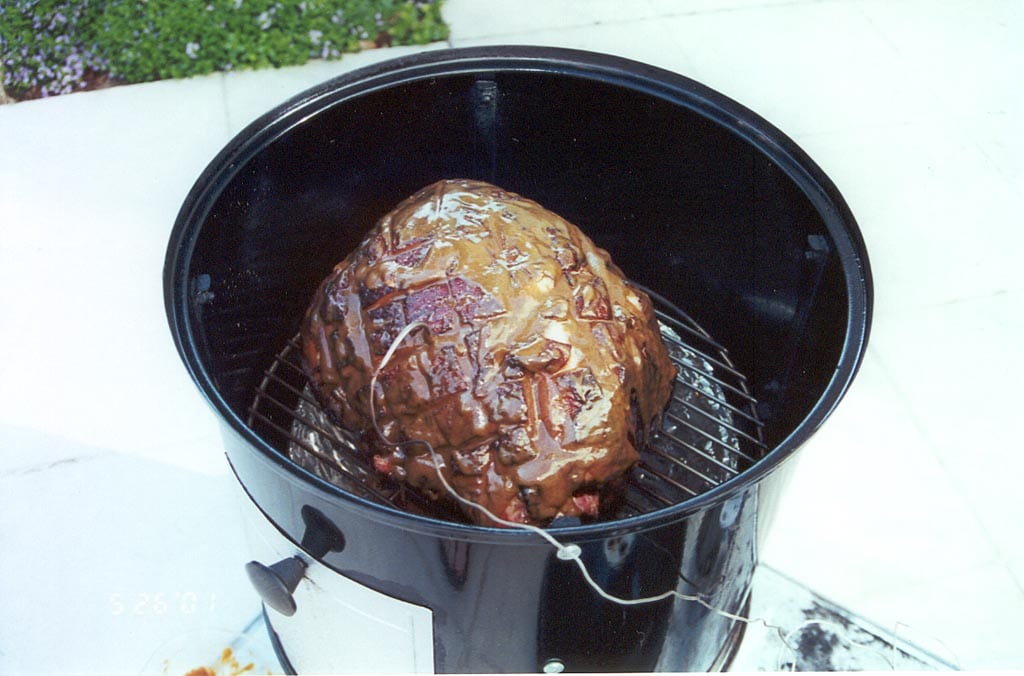 Here’s how the ham looked at 6:00pm when I poured and brushed the glaze over the scored surface. The ham took another 75 minutes to reach 154°F, at which time I removed it from the cooker.
It’s Ham-tastic!
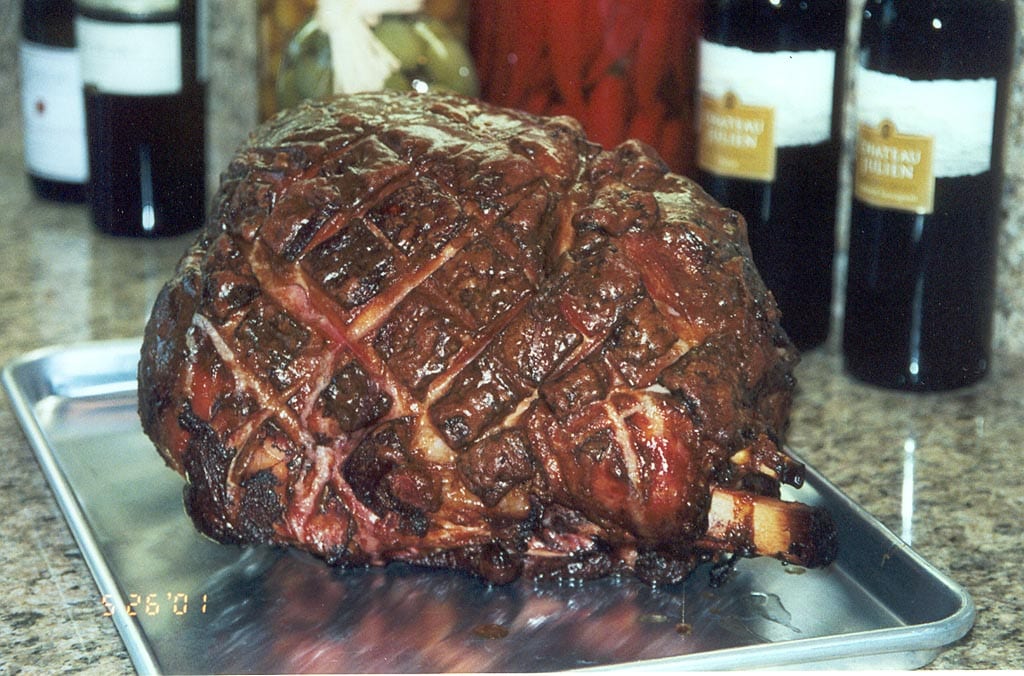
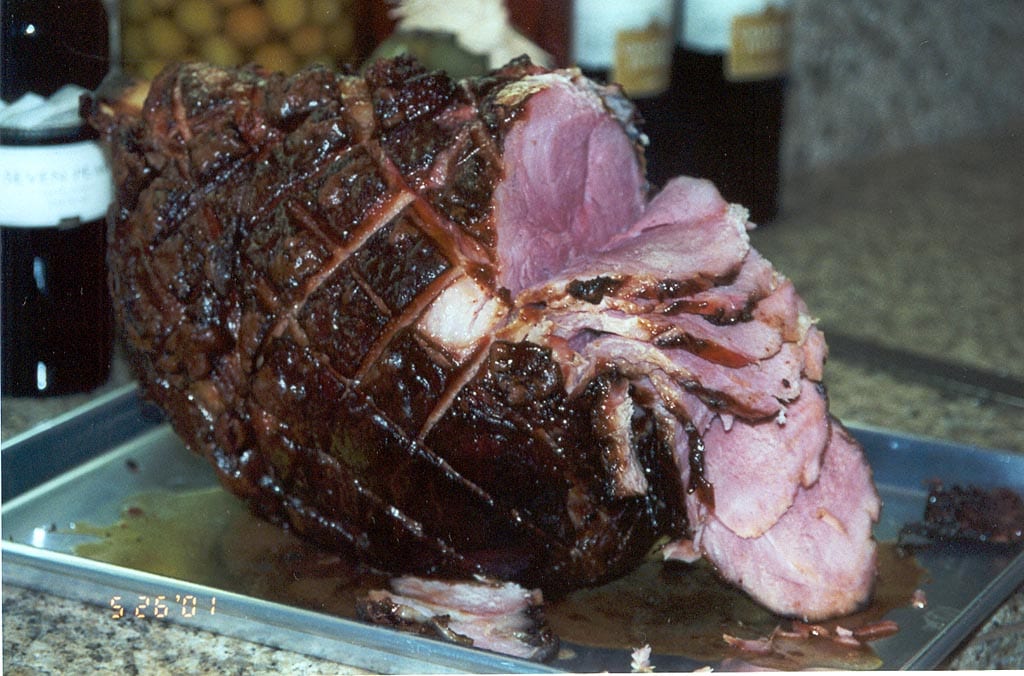
Here’s how the ham looked after coming out of the cooker. The ham rested for 30 minutes under a loose foil cover before carving.
Carving a ham this size is a little confusing, and I’m not sure I got it exactly right, but here’s what I tried to do:
- Cut a few thin slices from the side of the ham that is rounder in order to make a flat base.
- Stand the ham on the cut side and slice straight down to the bone in 1/4″ slices.
- Run the knife horizontally along the bone to remove the slices.
- Turn the ham over and carve 1/4″ slices in the same fashion.
The exterior of the ham had a beautiful color and the glaze added a nice flavor. The apple wood added a bit of smoky goodness to the outside of the ham, but was not overpowering and did not conflict with the hickory flavor added at the processing plant.
Closing Thoughts
- Remember, when cooking a whole, partially cooked ham in the WSM, you’re trying to replicate a 325°F oven environment with the addition of a small amount of smoke wood for flavor. You don’t want to cook this ham “low and slow” nor do you want to use the Minion Method to fire the cooker. Fill the charcoal chamber all the way to the top and make sure all the coals are covered with gray ash before assembling the cooker.
- Put the water pan in place, but don’t add any water to it. Otherwise you won’t be able to hold the cooker at 325°F.
- Make sure to line the water pan with aluminum foil. If you don’t, you’ll spend hours soaking and scrubbing the pan!
Since a whole ham is such a large piece of meat and is already cured and partially cooked, whatever you do in terms of seasoning, smoke wood and glaze will only affect the outside surface of the meat—your efforts are not going to have an impact on the flavor inside the meat.
But that’s OK. Cooking a whole ham on the WSM is a lot of fun and the subtle smokiness you’ll add will make that ham just a little bit more special. And if you do this during the holidays, you’ll free up the oven in the kitchen for other uses.
So get out there and cook a whole ham on the Weber Bullet. I hope you enjoy yours as much as I enjoyed mine!