In this topic:
- What Is Enhanced Meat?
- How Is Meat Enhanced?
- Why Is Meat Enhanced?
- Why Should You Care?
- How To Identify Enhanced Meat
- How To Identify Non-Enhanced Meat
- Closing Thoughts
What Is Enhanced Meat?
For the purposes of this discussion, enhanced meat can be defined as fresh, whole muscle meat that has been injected with a solution of water and other ingredients that may include salt, phosphates, antioxidants, and flavorings. Regular meat can be defined as fresh, whole muscle meat that has not been injected or marinated.
There’s really nothing sinister about enhanced meat. The self-basted Butterball turkey that you cook at Thanksgiving is an enhanced meat. When you brine chicken overnight in your refrigerator, you’re making enhanced meat.
The problem isn’t so much enhanced meat as a concept, but that in some parts of the country it’s becoming more difficult to buy certain cuts of meat that have not been enhanced—and conventional, non-enhanced meat is what most barbecue enthusiasts are looking for. Fresh pork is the best example of this trend. In some supermarkets, most fresh pork products, including spare and loin back ribs, butts, picnics, and loins, are available only as an enhanced pork product—non-enhanced versions of these same cuts are not available.
Fresh meat products that have been cured, injected, or marinated for convenience or to change the flavor characteristics of the meat are not the subject of this article. The corned beef brisket that you boil on St. Patrick’s Day is an enhanced meat product that contains a curing agent, but no one would mistake it for a regular brisket. Likewise, a whole chicken pre-marinated in Italian seasoning would not be confused with a regular chicken. In both cases, a non-enhanced version of brisket and chicken are available to consumers.
How Is Meat Enhanced?
Whole muscle meat is passed through a machine that injects the meat with a liquid solution. These computer-controlled devices have one or more injection heads containing many fine needles that pierce the meat. Complex pressure controls, filters, flexible needle mounts, and separate shut-off controls for each needle allow the solution to be injected evenly throughout the entire cut of meat, even those containing bones.
The meat may be weighed before and after injection to determine the percentage of solution added to the meat by weight.
Why Is Meat Enhanced?
There are many reasons why the meat industry is trending toward enhanced meats. Here are the most common ones discussed in trade publications and research papers.
Tenderness, Moisture, And Flavor
Due to food safety concerns, consumers tend to overcook pork and poultry. Enhanced meats retain more moisture, even when overcooked, resulting in a more tender “mouth feel”. When if comes to pork, much of the fat (and flavor) has been intentionally bred out of the animal by an industry intent on providing meat that appeals to health-conscious consumers. Enhancing pork helps add some flavor back to the meat.
Consumer Convenience
Consumers are spending much less time preparing meals than they did 10-20 years ago. Also, many people lack confidence in how to select and prepare meat. Enhanced meats are ready to cook, easy to prepare, and taste good to the average consumer.
Extended Shelf Life And Improved Food Safety
When meat is injected with a solution to enhance moisture and flavor, spoilage microorganisms can go along for the ride deep inside the meat. Adding a substance like sodium L-lactate to the solution delays or inhibits the growth of spoilage microorganisms, extending the shelf life of the meat by 30-50%. The result is better food safety for consumers and reduced economic loss for retailers.
Better Color And Moisture Retention, Less Rancidity
Injecting meat with a solution containing phosphates results in better meat color, increased water retention, and reduced rancidity caused by the oxidation of metal ions in meat. The combination of potassium L-lactate and salt can reduce the oxidation of fat, resulting in better color and odor in some refrigerated and frozen meats.
Reduced “Purge”
“Purge” is the liquid that accumulates in the bottom of the meat package during display in the meat case. Purge is not attractive to consumers and causes some retailers to remove and discard these products before their shelf life expiration date. This results in lost money for retailers and higher prices for consumers. Purge also occurs when frozen meats are thawed. Injecting a solution into meat can help tie up water and minimize purge.
New Product Development
Enhanced meat allows for the development of new processed fresh meat products that were previously not possible, like pre-marinated meats and seasoned fresh pork sausage.
Branding Of Meat
Meat producers can distinguish their products by putting their own brand name on enhanced meat products.
Increased Profitability
By “adding value” to meat by enhancing it, meat producers can charge more for their products and achieve higher profits. Also, by solving the problems of color retention and purge, enhanced meat facilitates the trend toward case-ready meat—meat that is butchered and packaged at the meat packing plant so that it’s ready for display and sale in retail stores. Case-ready meat is more profitable for meat producers and for retailers, and it represents the future of meat in America…and the demise of your local butcher.
Some people counter that enhanced meat is just a way for producers to make more profit by selling meat that’s pumped full of water. Don Schiefelbein, Executive Director of the American Gelbvieh Association, a cattle breeding association based in Westminster, Colorado, wrote the following in an article titled, “Lean & Tender vs. Lean & Tasty: Let’s Not Become Chicken”:
Note: As of 2/1/2007, this article was no longer available online.
“The lean and tender movement has already taken place in both the pork and poultry industry. The controlling entity (usually the packer) has driven the change in the name of consistency. Unfortunately, the leaner you make meat, the higher the risk of drying out the product during cooking. In order to manage dryness, the pork and poultry packers have aggressively begun offering moisture-enhanced products, i.e. lean and tender pork with water added. The result has been devastating to the pork industry. Lean and tender, moisture-enhanced pork now tastes just like chicken…
“Our beef industry is heading down that very same road. Packers have tremendous economic incentive to increase their profits and manage dryness in the lean product by adding water (moisture enhanced). Exactly the way it has already happened in the pork and poultry industry. The economics are simple. The more water you add, the more profit you make in the short run.”
But is enhanced meat really better than regular meat? Many barbecue enthusiasts think not, saying that enhanced meats taste too salty, “hammy”, or metallic. On the other hand, there are some competition barbecue teams winning big with enhanced pork products, spurred on my loyalty programs and financial incentives offered by Smithfield to use their enhanced ribs and pork butts in competition.
In a blind taste test sponsored by the U.S. Meat Export Federation, out of 250 influential Caribbean chefs, 90% chose enhanced pork as having the best flavor and texture in a typical foodservice setting. In a 2002 study of enhanced pork chops conducted by the Colorado State University Department of Animal Sciences, “the enhanced products were very similar to each other and superior to the non-enhanced products for sensory traits and WBS force measurements (a measure of tenderness). Enhancing the products with sodium phosphate and sodium lactate increases tenderness, juiciness, and moisture retention.”
Whatever your opinion, enhanced meat is becoming less expensive than regular meat because of the economies of scale that result from producing huge quantities of enhanced meat in highly efficient factories. Also, as regular meat becomes relegated to high-end markets and specialty butchers, the price differential between these two kinds of meat will become even greater.
Why Should You Care?
In my opinion, it’s important that you know what you’re buying. Let’s say you go to the supermarket and find slabs of loin back ribs in Cryovac packaging with a brand name you recognize. You don’t read the fine print on the package, assuming they’re regular ribs. You take the ribs home, apply a favorite rub, and cook them in the Weber Bullet like you’ve done countless times before. But this time, for some reason the ribs are too salty and taste “hammy”.
What went wrong? Did you use too much salt in the rub? Was it the smoke wood? In many cases, it turns out that the enhanced meat is the culprit.
Does this mean that enhanced meat is bad? Not necessarily. It all depends on what you’re looking for. If you like the price, convenience, and flavor of enhanced meat, then by all means buy it. Personally, when I cook ribs or pork butt in the WSM, I prefer to buy non-enhanced meat, which I think of as a “blank canvas” on which I can apply the flavors that I like. However, I’m not totally consistent on this point. When it comes to whole turkey, I may buy a Butterball turkey that’s been injected with a solution to enhance its moisture and flavor, or I may buy a natural turkey and dry brine it with salt or liquid brine it using a solution of my own creation. Either way, I’m cooking an enhanced turkey.
How To Identify Enhanced Meat
Just because meat is sold in Cryovac packaging or in a fancy butcher shop display case does not mean that it’s not enhanced meat. Even the word “natural” on the label does not guarantee non-enhanced meat.
Under federal law, the solution used to enhance meat must be disclosed on the package label. The label must list the total quantity and the common or usual name of the solution ingredients.
The only way to determine if meat has been enhanced is to carefully read the package label and ask lots of questions of the meat department personnel.
If you’re trying to avoid enhanced meat, you do not want to see any of the phrases listed below on the package label.
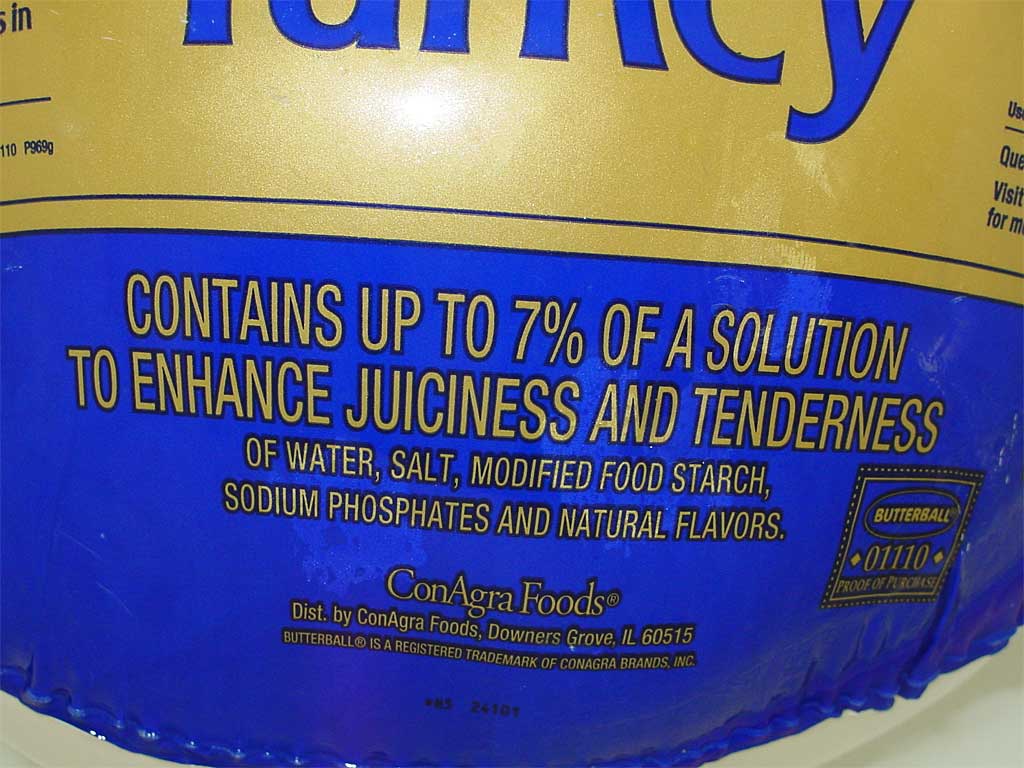 This Butterball frozen turkey reads:
“Contains up to 7% of a solution to enhance juiciness and tenderness of water, salt, modified food starch, sodium phosphates and natural flavors.”
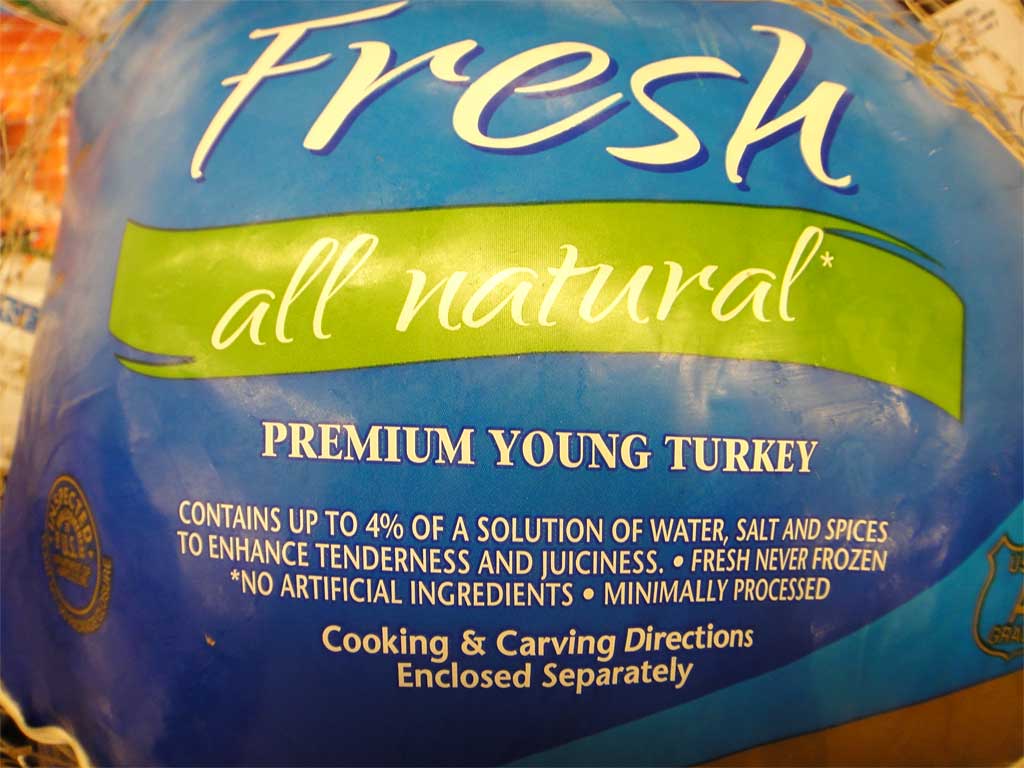
The story behind this turkey is a bit more confusing. The big print on this Butterball turkey says “FRESH” and “ALL NATURAL”. One could be forgiven for assuming this is a non-enhanced turkey. However, you’ll notice there’s a little asterisk at the end of “NATURAL”. The fine print on the label says:
“Contains up to 4% of a solution of water, salt and spices to enhance tenderness and juiciness. Fresh never frozen. *No artificial ingredients. Minimally processed.”
In this case, Butterball defines “all natural” to mean nothing artificial added. But clearly this is an enhanced turkey because of the use of a salt and spice solution. As you can see, “fresh, all natural” and “minimally processed” does not necessarily mean “not enhanced”.
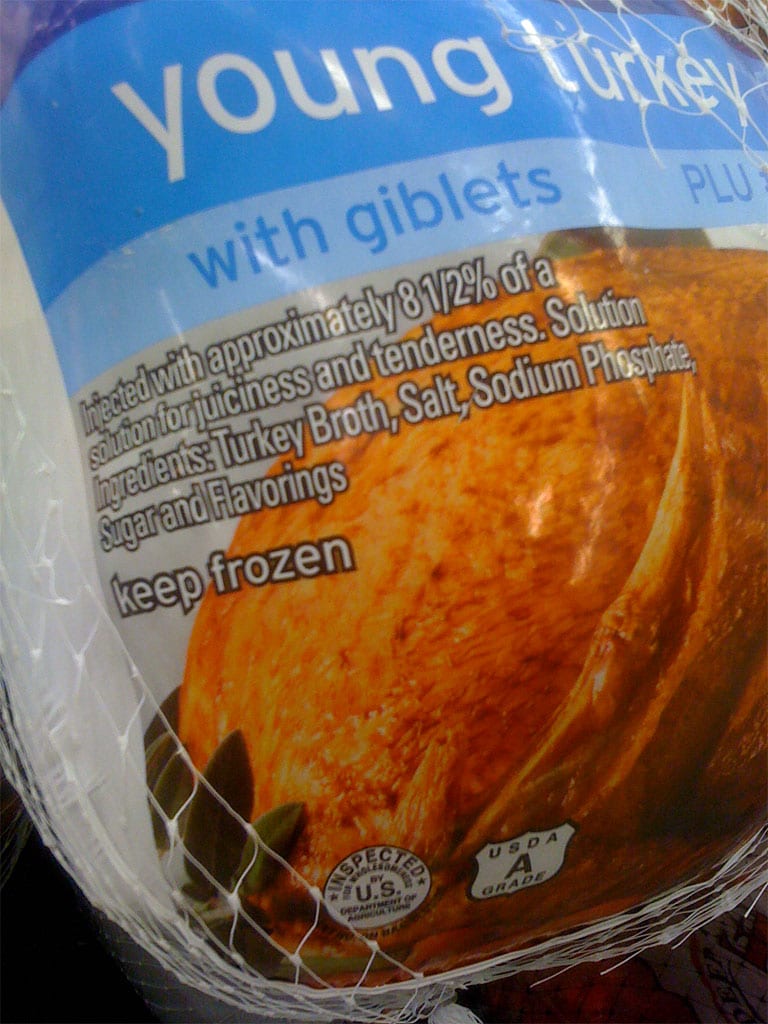
The grocery store brand frozen turkey reads:
“Injected with approximately 8-1/2% of a solution for juiciness and tenderness. Solution ingredients: Turkey broth, salt, sodium phosphate, sugar and flavorings”
Another brand of frozen bone-in turkey breast reads:
“Injected with up to 15% of a solution to enhance juiciness. Solution ingredients: turkey broth, salt, sugar, sodium phosphates, flavoring”
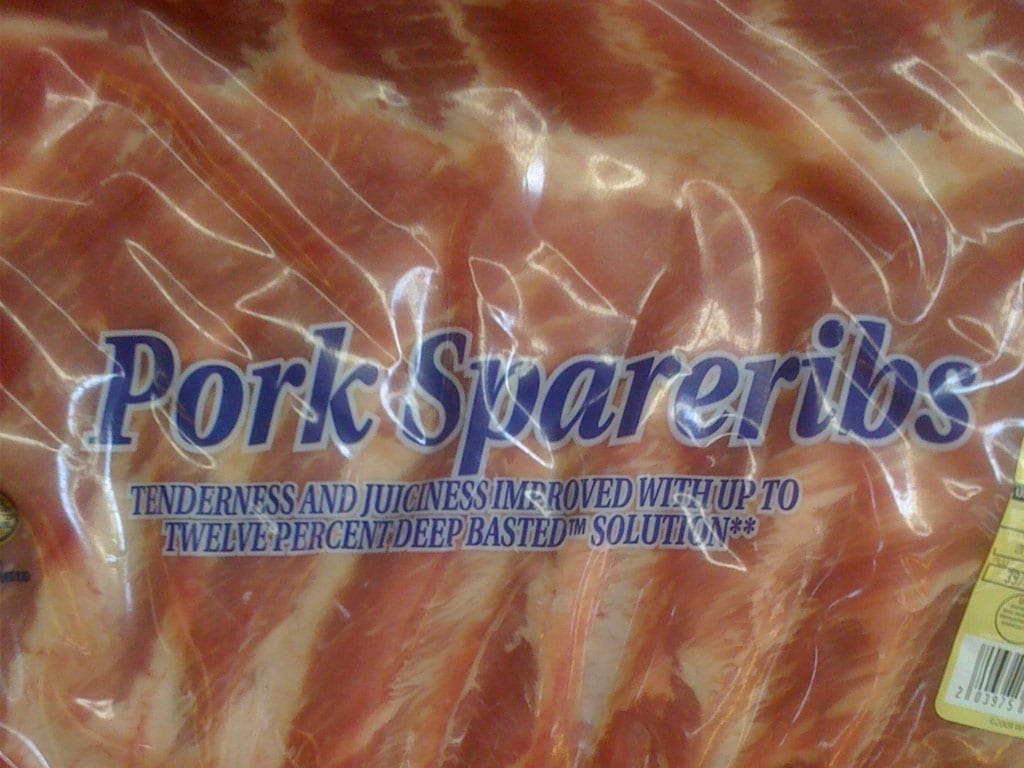
This national-brand of enhanced pork spareribs says on its label:
“Tenderness and moistness improved with up to twelve percent Deep BastedTM solution”
Another popular brand of enhanced pork ribs reads:
“Deep BastedTM by addition of up to 7% of a solution of water, sodium phosphates.”
Another brand of “premium” pork loin back ribs says:
“Moistness enhanced with up to an 8% solution*”
Then on the back of the package it says:
“*Solution ingredients: Water, salt, sodium phosphates”
Be on the look-out for the words “basted”, “enhanced”, “injected”, “improved” and “marinated”. Look for fancy packages with recognizable brand names that use phrases like “always tender”, “moist and juicy”, “tender and juicy”, “guaranteed tender”, and “extra tender”.
But what if the meat has been packaged (or repackaged) by the supermarket or is displayed unpackaged? In this case, ask the meat department personnel if the meat has been enhanced with a solution. If he or she says “No,” then say that you’re serious about old-fashioned, slow-cooked barbecue, and that you prefer conventional meat. Then ask, “Can you bring out the original box or Cryovac packaging so I can take a look?” Like Ronald Reagan said while negotiating nuclear arms reductions with the Soviet Union, “Trust, but verify.”
How To Identify Non-Enhanced Meat
Non-enhanced meat contains no added salt, solutions or flavorings. You should not see the phrase, “Contains up to X% of a solution to enhance tenderness and juiciness” on the label.
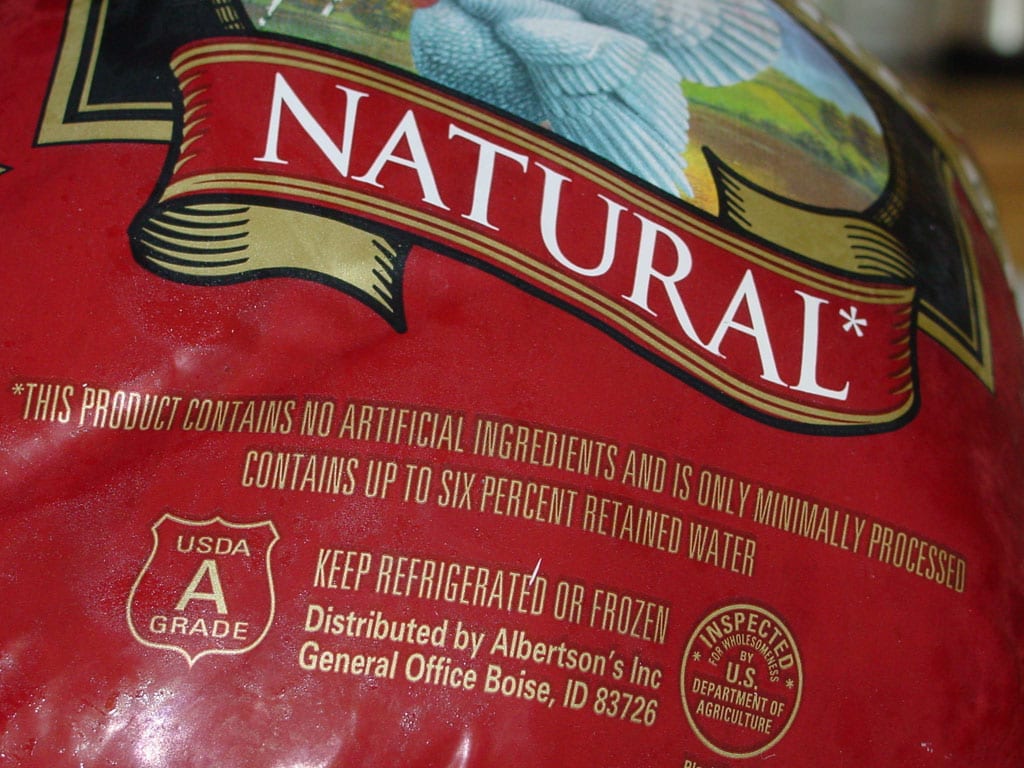 This photo shows the label for a regular, non-enhanced turkey. It may include a phrase like “Contains up to 6% retained water.” Do not confuse this with an enhanced turkey. Retained water is water that is absorbed and retained by the skin and meat as a result of washing and water-immersion chilling during processing. The USDA requires that poultry producers prove that the retained water is an unavoidable consequence of the process used to meet food safety requirements and that they list the actual or maximum percentage of retained water on the label.
Closing Thoughts
You have the right to know what you’re buying, but you also have the responsibility to be a careful shopper, read package labels, and ask the butcher about their products if you have any questions.
Enhanced meat is the wave of the future and it’s not going away. People who live in locations that don’t have many meat sources to choose from may end up having no choice but to accept enhanced meats and learn to adapt their barbecue recipes accordingly. For example, one might cut back on the amount of salt used in a rub.
In the meantime, tell your butcher and your grocery store manager that you prefer regular meat, if that’s your preference, and vote with your wallet. It may not make any difference in the long run, but hopefully there will always be sources out there providing fresh, conventional meat…even if the cost is higher.